
The U.S. martial arts studio industry includes 72,029 businesses generating $21 billion in annual revenue (IBISWorld, 2026). Almost every cost guide you'll find online is written from that perspective — commercial gyms with paid instructors, leased storefronts, and aggressive marketing budgets. But most martial arts schools in the world aren't gyms. They're dojos. And the economics are completely different.
I've been training Aikido for over a decade — currently 4th dan Aikikai — and as the founder of DojoMaster I've spoken with dozens of dojo founders across Europe. This article breaks down what running a dojo actually costs, in two stages: starting out, and operating an established school. The numbers reflect real European dojos, with a particular focus on what costs look like in a capital city like Berlin.
Key Takeaways
- A starting dojo can run for under €500/month — usually just per-hour rental of a shared sports space — and total startup costs are typically under €1,000.
- An established dojo with a dedicated 24/7 space in a capital city like Berlin runs €4,500–€6,500/month, with rent eating roughly 80% of the budget.
- Instructors are unpaid. Teaching is part of the path to 3rd and 4th dan. This single cultural fact changes everything about dojo economics.
- Up to 20% of paying members may be semi-active or rarely train. This is normal and actually adds financial resilience.
The Complete Guide to Dojo Management in 2026
How Much Does It Cost to Start a Dojo?
Almost nothing.
This is the first thing most cost guides get wrong. They quote startup figures of $30,000–$100,000 — but those numbers describe opening a commercial gym, not starting a dojo. A new dojo founded by an experienced practitioner typically launches for under €1,000 total.
Most new dojos start with under €1,000 in total upfront costs — per-hour hall rental, a simple website, and word-of-mouth recruitment through the founder's existing martial arts network. Renovation, dedicated space, and equipment investments come years later, if at all.
Here's what a typical starting dojo actually pays upfront:
The reason startup costs are so low: nobody starts a dojo on a whim. By the time someone is qualified to teach, they've trained for 10+ years and already have a network. Their first students aren't strangers acquired through Facebook ads — they're training partners, friends of friends, and practitioners from neighboring dojos who want to try something new. Word of mouth is the entire marketing channel at the start, and it works because the people doing the recommending are senior practitioners whose opinions are trusted.
A few notes on the line items above:
- Per-hour hall rental in Berlin runs €35–€40/hour for a private sports space, or €10–€25/hour through a registered Verein at a Bezirkssportanlage. Two sessions per week works out to €200–€600/month.
- Tatami is often not needed. Most rentable sports spaces come with mats. If you do need your own, used tatami from closing dojos sells at 30–50% of retail.
- Legal structure can be simple at first. The founder can teach as a freelance activity (freiberuflich) at the start, and convert to a Verein or gGmbH later once member count justifies the overhead.
From my experience: I started my Aikido practice in a shared space — renting mat time from a gymnastics club for evening hours. Total startup cost: virtually zero. The gymnastics club had mats, I didn't do any marketing and used a Facebook group as a public website. The tradeoff was zero control over the space and limited class times. But it let me build to 20+ students before anyone needed to think about a dedicated location. If you can find a shared-space arrangement, it's the only sensible way to start.

What Are the Monthly Operating Costs?
This depends entirely on whether you're running a starting dojo or an established one with a dedicated space.
A starting dojo renting hall time 2–3 times per week typically runs €300–€800/month all-in. An established dojo with a dedicated 24/7 space in a capital city like Berlin runs €4,500–€6,500/month — and rent alone accounts for €3,000–€6,000 of that, depending on whether the location is central or in a quieter district.
Monthly operating costs for an established dojo with a dedicated 24/7 space in a capital city run €4,500–€6,500, with rent eating roughly 80% of the budget. Unlike commercial gyms, staff costs are zero — instructors are unpaid because teaching is part of the martial arts path itself.
A few things jump out. Rent is the dominant cost — and the one with the widest range. A small evening-only rental might be €300/month. A dedicated 24/7 space in a capital city like Berlin runs €3,000–€6,000/month depending on location, with quieter districts at the low end and central areas at the high end.
The dramatic absence: staff costs are zero. In a traditional dojo, teaching is part of the practice. Senior students assist with classes, advanced practitioners lead sessions, and the head instructor doesn't draw a salary. We'll cover why this works — and why it's the foundation of dojo economics — in the next section.
Other recurring costs are small but real:
- Cleaning supplies and water/tea for after-class refreshments: €50–€100/month
- Equipment replacement (mats, weapons, repair work): €100–€300/month averaged across the year
- Insurance: €20–€80/month depending on member count and the art you teach
- Accounting (Steuerberater) for a Verein or gGmbH: €100–€250/month
- Software, website hosting, payment processing: €30–€80/month
- Federation membership and grading fees: €30–€100/month averaged
Dojo Management Software Pricing Compared (September 2026)
A Dojo Is Not a Gym
This is the most important section in this article, and the one you won't find in any other cost guide.
In traditional martial arts — Aikido, Karate, Judo, Iaido, Kenjutsu, and most Asian martial arts — teaching is not a job that gets posted on a hiring page. It's part of the path. To grade to 3rd or 4th dan, you are typically expected to have instructor experience. Teaching is how you deepen your own understanding. Senior students don't ask "how much does it pay?" — they ask "when can I start helping with the kids' class?"
This single cultural fact is the foundation of dojo economics.
A commercial gym with 100 members would need to pay:
- A head instructor: €40,000–€60,000/year
- Two or three assistant instructors: €15,000–€30,000/year combined
- A part-time admin: €10,000–€15,000/year
- Front desk and check-in staff for weekend events: €3,000–€5,000/year
That's €70,000–€110,000/year in labor costs alone — easily €6,000–€9,000/month — that a traditional dojo simply does not have. And it's not because dojos exploit their volunteers. It's because volunteering IS the structure. The community is the dojo.
This extends beyond teaching. Active members naturally take on roles:
- Website and IT: usually a member who works in tech
- Events and seminars: weekend check-ins, registration, hosting visiting teachers
- Federation liaison: someone handles paperwork, grading registrations, travel coordination
- Cleaning: students typically clean the mat themselves before and after class
If you're starting a dojo and thinking about "hiring instructors," you've fundamentally misunderstood the model. Your job as the founder isn't to staff an operation — it's to build a community where senior students naturally take on more responsibility as their skill and seniority grow.
This is why the cost numbers in most online guides — $7,500 to $26,000/month — don't apply. Those numbers describe a business. A dojo is something else.
How Much Revenue Can a Dojo Generate?
Dojo membership fees in Europe tend to fall into two clear tiers.
Starting dojos typically charge €50–€80/month for unlimited training. This is what most new dojos charge — enough to cover hall rental and basic costs while keeping the entry barrier low for new students.
Established top-tier dojos with dedicated 24/7 space, multiple classes per day, and a reputation in the city can charge €80–€130/month. These are clubs with 15+ classes per week, often with separate kids', beginners', and advanced classes plus a weapons or competition class, and pricing reflects the breadth of training available. Reduced tiers for children, students, and lower-income members are standard.
Deciding how to structure your fees? Read Martial Arts Pricing: One Unlimited Plan or Pricing Tiers?
Dojo revenue is more resilient than it looks. Up to 20% of paying members may be semi-active or rarely show up to class. They keep paying because they value being part of the dojo, plan to return, or simply don't get around to cancelling. This means real revenue tends to be higher than what "active headcount × fee" would suggest.
The "zombie member" phenomenon is worth understanding properly. In most dojos, 15–20% of paid members come once a month or less. Some return after long breaks. Some don't. This isn't a problem to fix — it's a structural advantage. It means your class sizes stay manageable while income stays stable. A 100-member dojo where 80 show up regularly and 20 pay-but-rarely-train is actually healthier than 100 fully active members all competing for mat space.
The 50-member inflection point: A starting dojo becomes self-sustaining at around 30–50 members. At €65/month average × 40 members = €2,600/month, which comfortably covers per-hour hall rental, insurance, and small equipment costs. Below this, the founder is typically subsidizing the dojo from their own pocket or treating it as a passion project, not a self-funded operation.
The biggest source of unexpected revenue loss isn’t churn — it’s billing leakage. See our guide to dojo payment collection for how to plug it.
What Surplus Should You Target?
A dojo isn't trying to maximize profit — it's trying to fund its own continuation and growth. The right frame isn't "profit margin" but "surplus": revenue minus costs, reinvested into seminars, equipment, federation travel, and gradual improvements to the space. A Verein or gGmbH typically can't distribute profits anyway, so the legal structure reinforces what tradition already requires.
Here's what those numbers look like in practice:
Note what's not in this table: a salary for the head instructor. Surplus in a dojo goes back into the dojo. The founder may receive reimbursements for documented expenses, but in a healthy Verein or gGmbH structure, surplus is reinvested into the community.
Member retention is the most important number after rent. The fitness industry average is 66.4% annual retention (HFA, 2025). Dojos that focus on community, ritual, and the path of the practice — rather than fitness outcomes — routinely beat this. A 5-year retention rate of 40%+ is achievable for a serious dojo, and it's the single biggest driver of long-term sustainability.
Want to keep more of your students? Read The Complete Guide to Student Retention for Martial Arts Schools.

Where Can You Cut Costs Without Cutting Quality?
Dojos fail for different reasons than gyms. A gym fails when marketing spend stops converting. A dojo fails when the founder burns out trying to do everything alone, or when fixed costs grow faster than the community can support.
Here's what actually saves money in a dojo:
Don't commit to a dedicated space too early. Per-hour hall rental scales with your usage. Dedicated rent doesn't. Stay on per-hour arrangements until you have 40–50 committed members training multiple times per week. The financial security of "no rent if no students" is worth more than the convenience of a permanent space.
Renovate gradually, not all at once. If you do move to a dedicated space, find one that's usable as-is. Major renovation — proper mat floor, changing rooms, kamiza, calligraphy — happens one improvement per quarter over several years. Spreading €30,000 of renovation over five years is the difference between manageable cash flow and a closed dojo.
Buy used tatami, or skip it. New tatami can cost €5,000–€15,000 for a small dojo. Used tatami from closing dojos or federation contacts sells at 30–50% of retail. Many spaces don't need tatami at all — judo mats are cheaper and work for most arts.
Keep your legal structure simple at first. A gGmbH or formally registered Verein involves real costs: accountant, audits, paperwork. At the start, the founder can teach as a freelance activity (freiberuflich) and convert to a Verein or gGmbH once member count justifies it. Don't pay for legal structure you don't need yet.
Use word of mouth until you have 30+ members. Paid marketing doesn't work for dojos the way it works for gyms. People don't sign up for traditional martial arts because of a Facebook ad — they sign up because someone they trust recommended it. Your existing network is the marketing channel.
Grow senior students into teaching roles. This isn't only about cost — it's about respecting how the art is transmitted. But it has a financial consequence: a dojo that nurtures its senior students never needs to hire instructors.
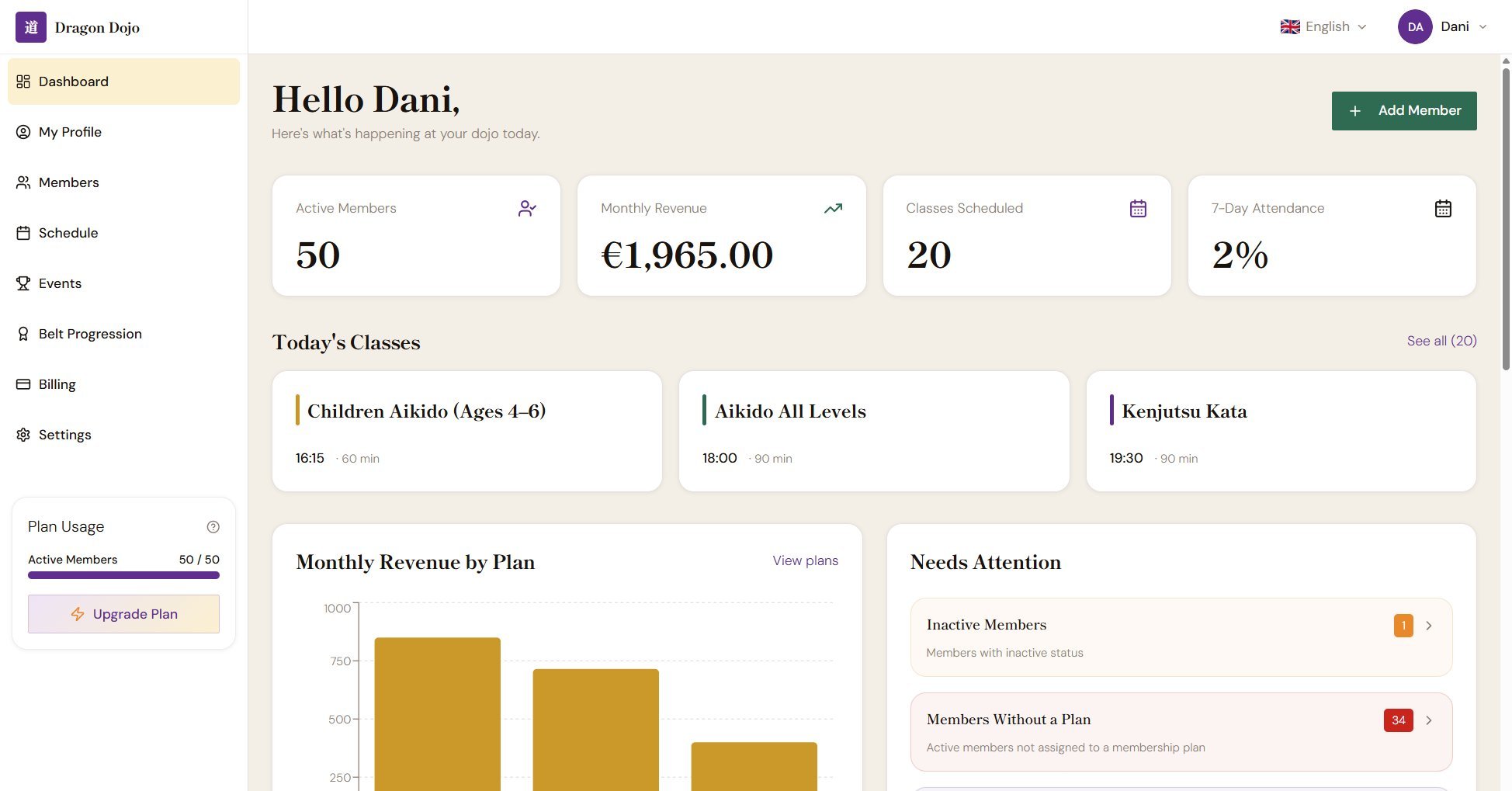
Software is cheap relative to admin time. A starting dojo can use DojoMaster's free tier for up to 20 students. Even the Starter plan at EUR 24/month is less than a single hour of your time per week. The cheapest software isn't the free one — it's the one that gives you the most hours back to teach.

Free vs Paid Dojo Management Software: What You Actually Get
7 Clear Signs Your Dojo Has Outgrown Excel
Frequently Asked Questions
Why don't dojos pay instructors?
In traditional martial arts, teaching is part of the path. To grade to 3rd or 4th dan in most Aikikai, Karate, Judo, and similar lineages, you're typically expected to have instructor experience. Teaching deepens your own practice and is considered a natural responsibility of advanced students, not a job to be hired for. This isn't exploitation — it's structural. A dojo without volunteer instructors isn't a dojo, it's a gym.
How many members do you need to start a dojo?
You can start with 5–10 members if you're renting hall space per hour. At €60/month average fee × 8 members = €480/month, which covers two weekly sessions at €40/hour. Most dojo founders begin with a network of training partners and friends who form the initial student base — this is why startup costs are so low.
When should you move to a dedicated 24/7 space?
When you have 40–50 committed members training multiple times per week. Dedicated space in a capital city like Berlin runs €3,000–€6,000/month, which means you need €6,000–€10,000 in monthly revenue to cover it comfortably along with other costs. Below 40 members, per-hour rental is almost always cheaper and more flexible.
What's the biggest financial mistake new dojo founders make?
Treating the dojo like a business from day one. New founders often want to register a Verein or gGmbH immediately, sign a dedicated lease, buy proper tatami, and build a polished website — spending €20,000+ before they have 30 members. A dojo earns the right to those things by growing. Start cheap, prove demand exists, then invest. The other big mistake: trying to hire paid instructors instead of growing senior students into teaching roles.
The Bottom Line
Running a dojo is fundamentally different from running a gym. A starting dojo can operate for under €500/month. An established dojo with dedicated 24/7 space in a capital city like Berlin runs €4,500–€6,500/month — almost entirely rent. Staff costs are zero because teaching is part of the practice, not a job.
This changes everything about how a dojo should be planned, funded, and grown. The cost guides quoting $7,500–$26,000/month aren't wrong — they're describing a different kind of operation entirely.
Three things matter most: start with per-hour rental until your community justifies dedicated space, invest in your senior students so they grow into teaching roles, and respect the cultural model that makes the entire economic structure work. The dojo isn't the building or the business — it's the community.
DojoMaster starts free for up to 20 students. Paid plans from EUR 24/month. Start free at dojomaster.app.
The Complete Guide to Dojo Management in 2026
Written by Daniil Pavliuchkov, 4th dan Aikido Aikikai and founder of DojoMaster. Sources: IBISWorld, Health & Fitness Association, market analysis of European dojos (2025-2026).