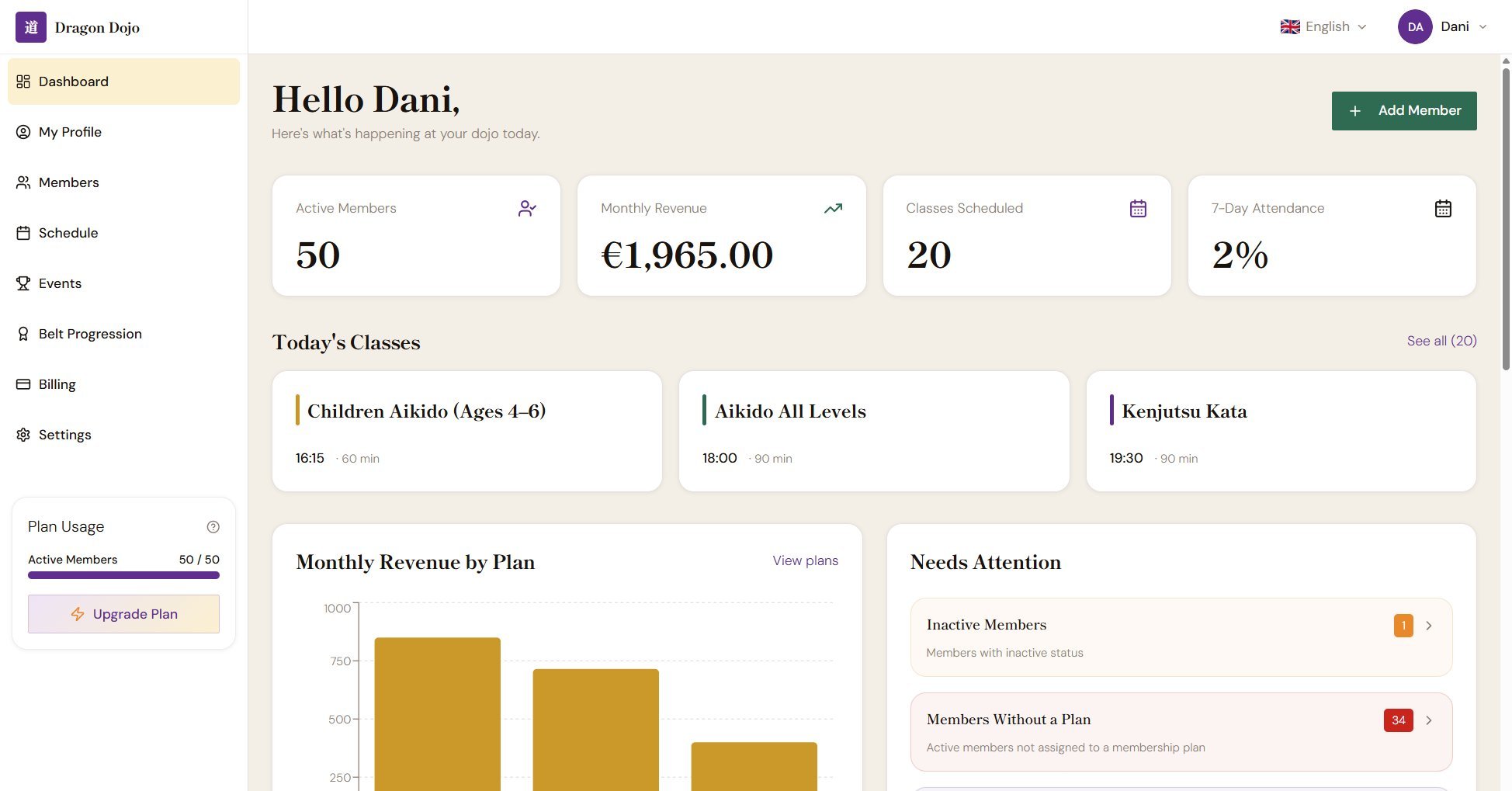


There are 72,000 martial arts businesses in the United States, generating $21 billion in annual revenue (IBISWorld, 2026). The industry has grown at 6.3% annually over the past five years. Yet most of these schools still run on spreadsheets, WhatsApp groups, and handwritten sign-in sheets.
Dojo owners are instructors first. They got into martial arts to teach, not to chase late payments or count attendance hours for belt eligibility. But the admin side doesn't shrink as a school grows. It compounds. A 50-student school that felt manageable on a spreadsheet becomes a 100-student school drowning in data entry.
This guide covers the six operational pillars of dojo management, explains when spreadsheets stop working, and breaks down what purpose-built software actually costs in 2026. I wrote it because I've lived every one of these problems. As a 4th dan Aikido Aikikai practitioner who ran his own dojo, I built DojoMaster after years of fighting the exact challenges described here.
Key Takeaways
- The fitness industry's average annual member retention is 66.4%, meaning a typical 100-student school loses about 34 members per year (HFA Benchmarking Report, 2025).
- Structured onboarding and follow-up achieve 87% retention at six months versus 60% without it (Dr. Paul Bedford / IHRSA, 2017).
- Purpose-built dojo software ranges from EUR 19/month to $500+/month, and the gap between cheapest and most expensive is wider than most owners realize.
Table of Contents
What Does Dojo Management Actually Involve?
Entrepreneurs spend 36% of their work week, roughly 16 hours, on administrative tasks rather than the core work of their business (Censuswide / Time Etc, 2023). For martial arts school owners, those 16 hours split across six areas that define dojo management: student records, belt progress, attendance, billing, events, and parent updates.
What makes dojo management harder than running a generic gym? Depth. A CrossFit box tracks memberships and check-ins. A martial arts school tracks all of that plus belt ranks and grading results, promotion readiness based on class counts, seminars and events, guest instructor logistics, and family links between parent and child accounts. These aren't edge cases. They're daily ops.
The six-pillar framework: Most dojo management guides focus exclusively on software features. But the operational needs come first: (1) student records, (2) belt progression, (3) attendance, (4) billing, (5) events, and (6) communication. Software that doesn't cover all six forces you back to spreadsheets for the gaps.
Schools under 30 students can often get by with tidy spreadsheets and a group chat. Between 30 and 50, cracks show. Why? The pillars start to interact. A parent asks about their child's belt readiness, which means checking attendance against promotion rules, which means knowing billing status. Above 50 students, these questions come daily. The time adds up fast.
Sage's 2025 research puts a number on it: small businesses lose 24 working days per year to financial admin alone. Nearly five full weeks (Sage, 2025). For a dojo owner who also teaches every class, that's five weeks not spent on the mat.
How Do You Track Students and Memberships Effectively?
The fitness industry's average annual retention is 66.4%, based on data from 17,000+ facilities across 27 countries (HFA, 2025). A 100-student school that hits the average loses about 34 members per year. Many don't leave because they dislike training. They leave because the school didn't follow up on missed classes, lost track of a billing issue, or let a student's progress slip through the cracks.
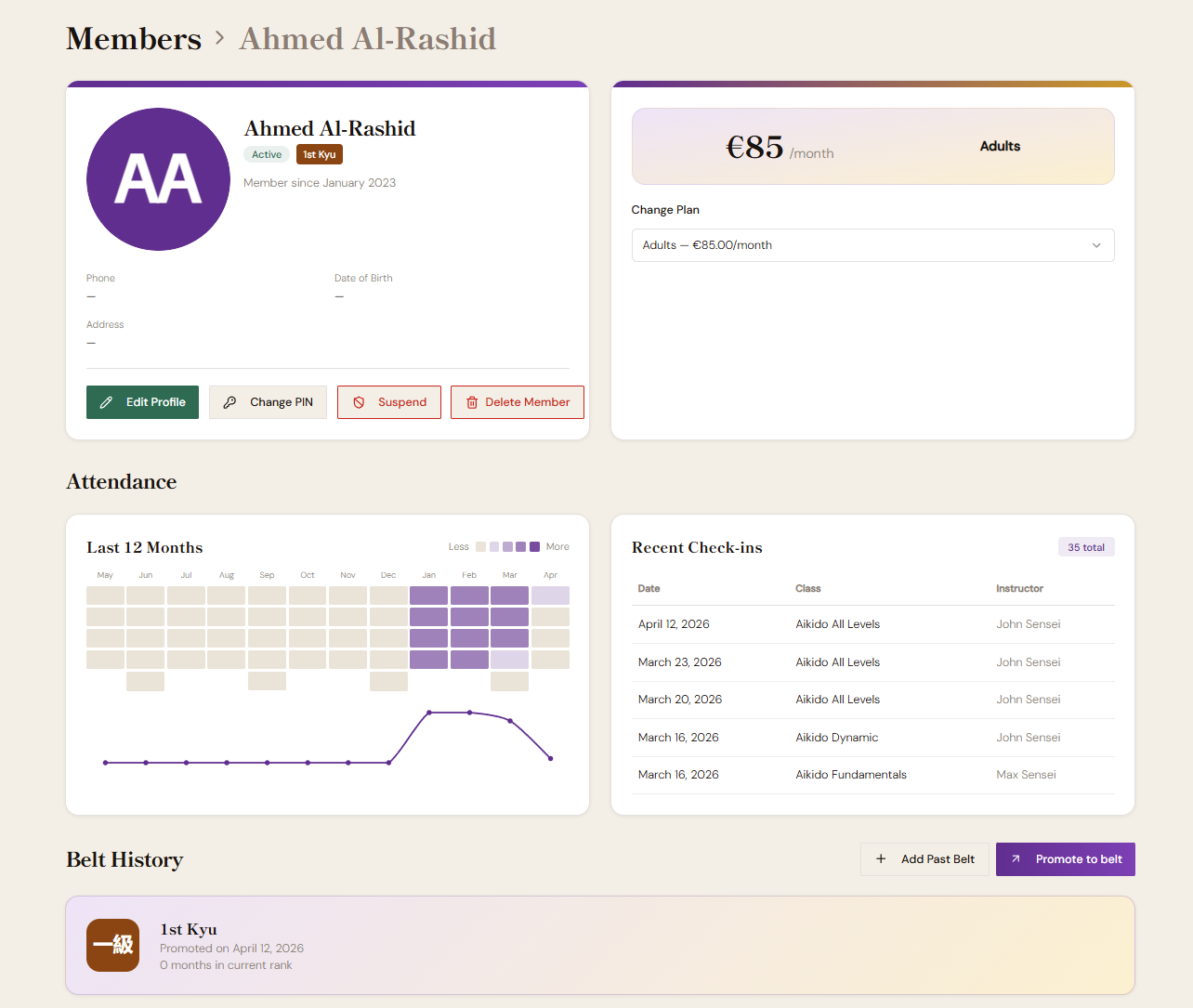
Good student management means every student has a complete profile you can pull up in seconds. At minimum, it should include:
- Contact details and emergency contacts
- Membership status (active, paused, expired) with start and renewal dates
- Belt rank and promotion history
- Attendance record with class-by-class detail
- Family links (connect a parent account to 2-3 child students)
- Payment history and current billing status
- Medical notes or training restrictions
Dr. Paul Bedford studied roughly 1,000 UK gym members and found that structured onboarding (an orientation plus three follow-up sessions) kept 87% of members at six months. Without it? Just 60%. At twelve months, the gap widened: 70% versus 38% (Dr. Paul Bedford / IHRSA, 2017). Software makes this kind of follow-up possible at scale. When a student's data lives in one place, instructors spot warning signs early. Three missed classes in two weeks? That student needs a check-in before they drift away.
From my own dojo: When I ran my Aikido classes on Google Sheets, I had one tab for attendance, another for belt records, and a third for payments. When a parent asked me "How close is my daughter to her next belt?", I had to cross-reference three spreadsheets. That question should take three seconds, not three minutes.
For European schools, student data also means GDPR. Profiles contain personal info and payment details, so your system needs to handle data access requests, consent records, and deletion rights. This isn't optional in the EU.
Why Is Belt and Rank Tracking So Hard to Get Right?
ABC Fitness data from 30,000 facilities shows that 88% of studio operators consider their instructors "absolutely critical" to retention (ABC Fitness, 2025). In martial arts, the instructor-student bond centers on belt progress. But tracking it is harder than it looks. For a 100-student school, that's 100+ individual records to maintain. Each one has its own rules, timeline, and assessment criteria.
Belt systems aren't standard. Karate uses kyu and dan ranks with colored belts. BJJ uses white through black with stripes. Aikido uses kyu/dan but with no sparring: grading tests technique and uke/nage balance. Taekwondo uses its own color sequence. Can your software handle all of these? Schools that teach martial arts need a system flexible enough to handle whichever belt system their art uses.

Generic fitness software fails here because it doesn't get "promotion readiness." A dojo-specific system tracks classes attended since the last belt, checks time since last promotion, and flags students as ready for testing. When this happens on its own, instructors never miss a promotion window. Students never feel forgotten.
IHRSA found that just two staff check-ins per member per month cuts cancellation risk by 33% (IHRSA, 2017). In martial arts, where the teacher-student bond is the product, that effect is likely even stronger. Belt progress is the most visible form of that bond. When a student can see "12 more classes until green belt," they have a real reason to show up.
Traditional arts vs. modern combat sports: Most dojo software is designed with MMA or BJJ in mind. If you teach a traditional art like Aikido, Judo, or Iaido, your grading system likely includes kata evaluation, weapons proficiency, or demonstration requirements that don't map to a simple "attendance count + time" formula. Ask any software vendor how they handle custom promotion criteria before you commit.
Want to set this up step by step? Read How to Track Belt Promotions Digitally.
What Is the Most Efficient Way to Track Attendance?
Over 45% of gyms in North America now use cloud-based software for attendance, memberships, and scheduling (Statista, 2024). For martial arts schools, attendance data does double duty: it drives belt promotion readiness and reveals churn patterns before students leave.

There are four common methods, each with trade-offs:
Manual sign-in sheets. Paper on a clipboard. Zero setup cost, but error-prone. You can't query a paper sheet to find which students haven't attended in two weeks. And when it's time for belt testing, someone has to manually count every student's classes.
QR code check-in. Students scan a code on their phone when they arrive. Low cost, quick, and eliminates handwriting errors. The downside? Not every student (especially children) carries a phone.
Kiosk check-in. A tablet at the front door displays today's classes. Students tap their name to check in. This works well for all ages and doubles as a welcome screen showing upcoming events and announcements.
NFC or card-based. Students tap a key fob or membership card. Fast and reliable, but it requires hardware and card management.
The method matters less than what you do with the data. ABC Fitness's 2025 report, covering 30,000 facilities and 600 million check-ins, found that members with five visits in their first month retain at over 90% (ABC Fitness, 2025). Attendance tracking should feed into three things on its own: belt promotion readiness, retention dashboards (who's at risk?), and revenue forecasting (how does attendance predict renewals?).
If your attendance system is disconnected from your belt tracking, you're doing double work. If it's disconnected from your billing, you're missing early signals of churn.
Not sure which check-in method fits? Read Manual vs Automated Attendance Tracking.
How Should a Dojo Handle Billing and Payments?
About one in four failed payments is involuntary: expired cards, declined charges, or outdated payment details, not real decisions to leave (Recurly, 2025). Think about that. A big chunk of the students that don't pay on time actually never chose that. Their card expired. Their bank said no. They forgot to update a number. Automated billing with retry logic (dunning) fixes this in the background.
Churnkey's 2025 report, based on 6 million failed payments across 1,000+ companies, found that automated retry systems recover 40-60% of failed charges (Churnkey, 2025). For a dojo pulling in $15,000 per month, that could mean $1,500 saved each month, or $18,000 per year. Automated billing doesn't just save time. It plugs a leak most school owners don't even know they have.
Small businesses lose 24 working days per year to financial admin: invoicing, chasing payments, fixing errors (Sage, 2025). That's five full weeks. For a dojo owner who also teaches every class, those are weeks stolen from the mat.
Billing in a martial arts school has specific wrinkles:
- Family billing. A parent with three children in different classes needs one invoice, not three.
- Tiered pricing. Unlimited classes vs. twice-a-week plans vs. drop-in rates.
- Promotion fees. Some schools charge separately for belt testing events.
- Trial periods. Free first week or discounted first month for new students.
- Payment methods. Credit card via Stripe is standard in the US. In Europe, SEPA Direct Debit mandates are the norm, and most US-built dojo software doesn't support them natively.
European dojos face a unique gap. Most martial arts management software is built in the US and processes payments through Stripe (credit card only). In Germany, Austria, and Switzerland, gym and dojo memberships are typically paid via SEPA Direct Debit, a bank-to-bank mandate system. If your school operates in Europe, check whether your software handles SEPA mandates natively. DojoMaster is one of the few that does.
Role-based access matters here too. Your instructors need to see who's in class and what belt they hold. They don't need to see payment history, outstanding invoices, or membership pricing. A well-designed system separates teaching functions from financial functions.
Want the full playbook for collecting tuition? Read our Guide to Dojo Payment Collection.
What Else Should Dojo Software Handle?
Seventy-three percent of fitness members say being part of a community helps them stay motivated (ABC Fitness, 2025). Building that community takes more than great classes. It takes events, parent updates, and multi-staff coordination. These are the features that separate purpose-built martial arts tools from spreadsheets and generic gym software.
Events and seminars. Most dojos host belt grading events, competitions, guest instructor seminars, summer camps, and multi-day workshops at least a few times per year. Managing RSVPs, collecting event fees, printing attendance lists, and tracking which students actually showed up adds admin layers that don't fit in a spreadsheet formula.
Parent and student communication. The Aspen Institute surveyed 3,827 youth across all 50 US states and found that 86% of kids still playing sports have parents who show up to practices and games. Among kids who quit? Just 58% (Aspen Institute / Project Play, 2025). That 28-point gap is one of the strongest predictors of whether a young athlete stays or leaves. For a kids-heavy dojo, automated parent updates and belt-promotion alerts are the digital version of a parent sitting in the bleachers.
Multi-instructor access. Once a school has more than one teacher, you need role-based logins. The head instructor sees everything. Assistants see class lists and belts. A front-desk volunteer sees check-in and contact info. Nobody except the owner sees money.
Kiosk mode. A tablet by the front door that shows today's schedule and lets students check in gives the dojo a professional feel and captures attendance data automatically. For schools that share space with other activities (community centers, church halls), the kiosk also signals "this is a real martial arts school, not just a weekly club."
How Much Does Dojo Management Software Cost in 2026?
The gym software market hit $384 million in 2024 and is on track to reach $1 billion by 2033, growing at 11% per year (Business Research Insights, 2025). Pricing for martial arts tools varies wildly: free (with big limits) to $500+ per month for multi-location setups. Here's what a 100-student school actually pays:
| Software | Monthly Price (billed annually) | Annual Cost | Free Trial |
|---|---|---|---|
| DojoMasterBest value | €49/mo | €588/yr | Yes + Free plan (20 students) |
| DojoTrack | $95/mo | $1,140/yr | 14 days |
| Martialytics | $99/mo | $1,188/yr | Yes |
| Gymdesk | $100/mo | $1,200/yr | 30 days |
| Kicksite | $149/mo | $1,788/yr | Yes |
| Zen Planner | $189/mo | $2,268/yr | Yes |
The pricing gap is real. DojoMaster's annual plan for 100 students costs EUR 588/year, less than half of what Kicksite or Zen Planner charge. All plans include student management, belt tracking, attendance, payments, events, and instructor logins. The difference comes from a lean operating model: solo founder, no marketing budget, no sales team.
The table above shows base subscription prices. Watch for hidden costs that inflate the real number:
- Payment processing fees (typically 2.9% + $0.30 per transaction on top of the subscription)
- Per-student charges (some platforms charge extra above a student threshold)
- Setup fees (one-time onboarding charges, sometimes $200-$500)
- Contract lock-in (annual contracts with early termination penalties)
Don't compare monthly prices. Compare annual total cost of ownership, including processing fees on your monthly billing volume. For a 100-student school collecting $100/month per student, processing fees alone can add $3,500/year.
Want the numbers vendor by vendor? Read How Much Dojo Software Costs in 2026.
Wondering whether a free plan is enough? Read Free vs Paid Dojo Management Software.
When Should You Switch From Spreadsheets to Software?
Ninety-four percent of business spreadsheets examined in audits contained errors (Frontiers in Computer Science, 2024). When your student records, belt data, and billing all live in spreadsheets, the question isn't if something will break. It's when.
Here are five signals that you've outgrown spreadsheets:
- You have 30+ active students and cross-referencing attendance with belt eligibility takes more than a few minutes.
- You've missed a belt promotion because a student's attendance count was wrong in your spreadsheet.
- You're chasing payments manually, texting or emailing students about overdue fees every month.
- A parent asked a question you couldn't answer without digging through multiple tabs or files.
- You've lost data. A file got corrupted, a tab was accidentally deleted, or your laptop died.
If three or more apply, you're past the tipping point. Software starts at EUR 19/month. Losing one student per month costs far more than that.
How big is the retention payoff of getting organized? The data is clear:
The chart tells the story. Schools that onboard and follow up keep nearly twice as many students at twelve months. That's exactly what software automates: welcome sequences, missed-class alerts, and progress updates.
And the switch is less painful than you'd think. Most dojo software supports CSV import from Excel or Google Sheets. A school with 100 students can migrate in 30-60 minutes.
Want the full checklist? Read 7 Signs Your Dojo Has Outgrown Excel.
What Should You Look for in Dojo Software?
The gym software market is growing at 11% per year and will approach $1 billion by 2033 (Business Research Insights, 2025). With dozens of options, here are the features that matter most for martial arts schools, in priority order:

- Belt and rank tracking with custom promotion rules. This is what sets dojo software apart from gym tools. You need to define custom belt setups, set class counts and time-in-rank per belt, and get alerts when students become ready. If the software can't handle your belt system, it isn't built for martial arts.
- Automated billing with failed payment recovery. Monthly recurring billing, family invoices, and auto-retry on failed payments. For European schools: native SEPA Direct Debit support.
- Attendance tied to belt readiness. Your check-in system should feed class counts into each student's promotion progress on its own. If attendance and belt tracking live in separate modules, you're still doing manual work.
- Student profiles with family linking. Parent-child account relationships, shared billing, and the ability to view a family's entire dojo engagement from one screen.
- Role-based access for instructors. Instructors see class lists and belts. They don't see payments. The owner sees everything. Not a nice-to-have: it's a trust issue.
Also consider: Mobile access (can you mark attendance from your phone?), data export (can you leave if you want?), GDPR compliance (required in Europe), and a free trial or free plan. Never commit to annual billing without testing first.
Frequently Asked Questions
How many students before I need management software?
At 30+ active students, admin work typically exceeds 10 hours per week. Entrepreneurs already spend 36% of their time on admin tasks on average (Censuswide / Time Etc, 2023). Below 30, organized spreadsheets can work if you're disciplined. Above 50, software pays for itself in time savings alone. The real trigger isn't a student count: it's when you start making mistakes because of manual processes.
Is dojo management software expensive?
Prices range from free (limited to 20-30 students) to $500+ per month for multi-location enterprise setups. For a typical single-location school with 50-150 students, expect $49-$149 per month from most vendors. DojoMaster is an outlier at EUR 19-99/month. The question isn't whether you can afford software; it's whether you can afford the admin hours you're spending on manual work.
Can I import my existing student data from Excel?
Yes. Most modern dojo management platforms support CSV import from Excel and Google Sheets. You'll export your student data as a CSV file, map your columns to the software's fields (name, email, belt rank, etc.), and import. For a 100-student school, migration typically takes 30-60 minutes including cleanup.
Do my instructors need to learn the whole system?
No. Role-based access means instructors only see what they need: class attendance lists, student belt status, and promotion eligibility. They don't see payments, billing, or admin settings. Most instructors learn their view of the system in a single class session: tap their name, see their students, mark attendance.
What if my belt system doesn't match the software's templates?
Purpose-built dojo software supports custom belt configurations. You define belt names, colors, required class counts, minimum time-at-rank, and curriculum checkpoints for each rank.
Getting Started
Step 1: Audit your current workflow. Write down every admin task you do weekly: attendance, billing, belt tracking, parent messages, event planning. Time each one for a single week. If the total exceeds 10 hours, you'll recoup that time with software.
Step 2: Test before you commit. Sign up for a free plan or free trial. Import a small batch of students (10-20) and run your next week of classes through the system. Check whether belt tracking, attendance, and billing work the way you need.
Step 3: Migrate fully. Import your complete student roster, set up your belt hierarchies and billing plans, and go live. Most schools complete this in under a day. Don't run parallel systems (old spreadsheet + new software) for more than a week. It doubles the work and delays the payoff.
DojoMaster offers a free plan for up to 20 students with all features included, no credit card required, no trial expiration. Start free at dojomaster.app.
Continue Learning
How-to guides:
- 7 Clear Signs Your Dojo Has Outgrown Excel
- How to Track Belt Promotions Digitally (Without Spreadsheets)
- Martial Arts Attendance Tracking: Manual vs Automated
Billing and pricing:
- The Dojo Owner’s Guide to Payment Collection in 2026
- How Much Does Dojo Management Software Actually Cost?
- Free vs Paid Dojo Management Software
- How Much Does It Cost to Run a Martial Arts School?
- What Is a SEPA Direct Debit Mandate? A Guide for Dojo Owners
- What to Do When a Student's Payment Fails (and How to Prevent It)
- Martial Arts Pricing: One Unlimited Plan or Pricing Tiers?
Student retention:
- The Complete Guide to Student Retention for Martial Arts Schools
- The 90-Day Dropout Window: 23 Proven Tactics to Keep New Students
- Belt Progression as a Retention Tool: How Visible Progress Keeps Students
Written by Daniil Pavliuchkov, 4th dan Aikido Aikikai and founder of DojoMaster. Built with data from IBISWorld, HFA (formerly IHRSA), ABC Fitness, Recurly, Aspen Institute / Project Play, Frontiers in Computer Science, and Sage.