

Members who reach five visits retain at over 90%, according to the 2026 Boutique Fitness Industry Report (Xplor Mariana Tek, 2026). That's a powerful number. But here's the problem: most martial arts schools can't tell you which students have hit five visits because their attendance data lives on a paper clipboard or a disconnected spreadsheet.
Attendance tracking in martial arts isn't just headcount. It feeds belt promotion readiness, flags at-risk students, and predicts revenue months before a cancellation happens. Yet the majority of schools still track it manually, creating data that sits in a file until someone moves it by hand.
This guide compares seven martial arts attendance tracking methods side by side — including the one most schools don't admit to using — from no tracking at all to kiosk check-in, so you can pick the right system for your school. I ran my own dojo's attendance in Google Sheets for two years before building DojoMaster. The lessons here come from that experience.
Key Takeaways
- Paper-based data capture has a 5.1% error rate vs 3.1% for electronic systems (PLOS ONE, 2021).
- Members who reach 5 visits retain at over 90%, but you can't track this on a clipboard (Mariana Tek, 2026).
- Automated attendance feeds belt promotion readiness, flags at-risk students, and shows trends over time.
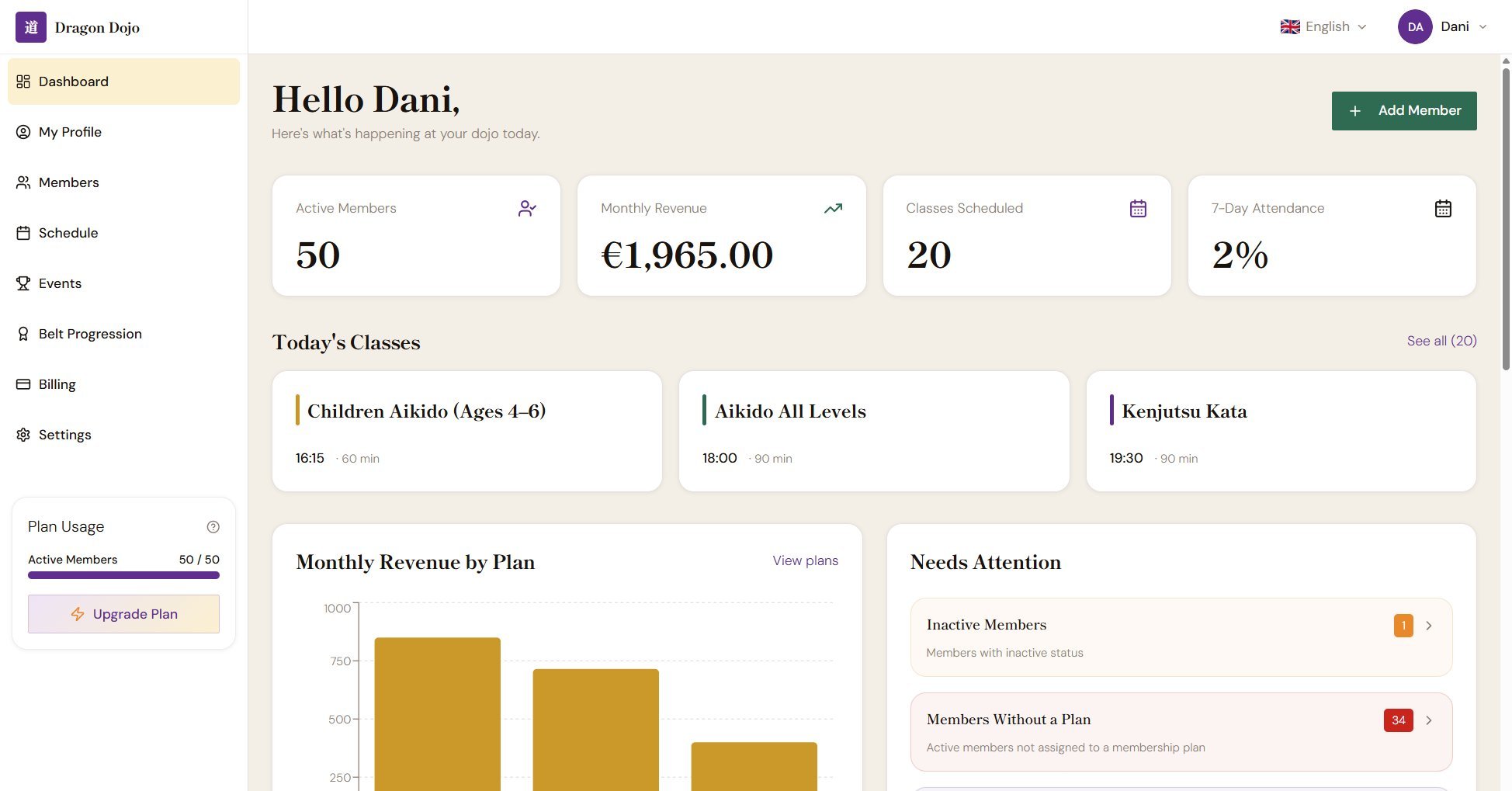
- DojoMaster includes kiosk check-in, instructor roll call, and attendance heatmaps starting at EUR 19/month.
For the full picture on running a modern school, see The Complete Guide to Dojo Management in 2026.
Why Does Attendance Data Matter More Than You Think?
Average annual gym member retention is 66.4%, based on data from 17,000+ facilities across 27 countries (HFA, 2025). Nearly half of new members cancel within six months (Hooker et al., Preventive Medicine Reports, 2016). In martial arts, attendance data is the earliest warning you get before a student disappears.
Average annual gym member retention is just 66.4% across 17,000+ facilities worldwide (HFA, 2025), and nearly half of new members cancel within six months (Hooker et al., Preventive Medicine Reports, 2016). Attendance tracking is the earliest tool a dojo owner has to spot declining engagement before it becomes a cancellation.
Your attendance data should do three things without any manual effort:
Flag at-risk students early
A student who drops from three classes per week to one is on their way out. You won't see this on a paper sign-in sheet. By the time you notice the absence, they've already made the decision to leave. Connected software catches the trend while there's still time to reach out.
Feed belt promotion readiness
Every class attended counts toward the next belt. If attendance and belt tracking live in separate systems, someone has to count manually. That means opening a spreadsheet, finding the student, scrolling through rows, and tallying. For 80 students? That's hours of work each testing cycle.
Predict revenue
Attendance trends forecast renewals and cancellations months before they happen. A class that averaged 18 students in January and now averages 12 in March is telling you something about your summer revenue. Are you listening?
Here's where it gets specific. Retention climbs steadily between visits one and four, then holds above 90% once a student reaches visit five (Xplor Mariana Tek, 2026). If your attendance system can't tell you who's at visit three and needs a nudge, you're leaving retention on the table.

Not sure if your tracking system is holding you back? Read 7 Signs Your Dojo Has Outgrown Excel.
How Does Manual Attendance Tracking Work?
Paper-based data capture has a 5.1% error rate, compared to 3.1% for electronic data capture, according to a peer-reviewed study analyzing 28,116 data points (PLOS ONE, 2021). That gap compounds fast when you're tracking 50+ students across 15+ weekly classes.
A peer-reviewed PLOS ONE study (2021) found that paper-based data capture has a 5.1% error rate versus 3.1% for electronic systems, based on 28,116 data points. For a martial arts school tracking hundreds of check-ins per week, that difference means dozens of incorrect records each month.
Three methods represent the manual end of the spectrum — including the one nobody puts in their marketing materials:
No tracking at all
Many small dojos run on memory alone. No sheet, no spreadsheet — the instructor simply remembers who showed up. Zero cost, zero setup, zero data. It works until the school grows past a handful of students, at which point the cracks become structural.
Here's what happens when there's no attendance record:
- Belt decisions become guesswork. Was Maya at 40 classes or 38? No one knows. Instructors either delay promotions to be safe or advance students who haven't earned it yet. Both outcomes erode trust — with students, with parents, and across the school.
- At-risk students vanish without warning. A student who attended three times a week in January and once in March looks identical to one who just started, because you have no record of either. By the time the pattern is obvious, the cancellation has already happened.
- Parents can't get answers. "How many classes has my son attended this month?" becomes an unanswerable question. That loss of transparency damages the school's credibility far more than any equipment or curriculum gap.
- Revenue surprises you. A class that's quietly shrinking won't register until enrollment numbers collapse. There's no trend to read, no early signal to act on — only the shock of empty mats.
- Scaling becomes impossible. The instructor's memory is the system. When a second instructor joins, or classes split across time slots, that system breaks immediately. There's no handover and no continuity.
The hidden cost of doing nothing: Not tracking attendance feels like zero effort. In reality, it's a slow transfer of control — from you to chance. Every belt decision made from memory, every missed at-risk signal, every unanswered parent question is a compounding liability. The longer a school runs without attendance data, the harder it becomes to introduce it, because there's no baseline to measure against.
Paper sign-in sheets
A clipboard by the door. Students write their name when they arrive. Zero cost, zero setup. But you can't search it, sort it, or query it. How many classes has Taro attended since his last belt test? Nobody knows without counting rows by hand. Handwriting errors make it worse, especially with kids.
Spreadsheet tracking
Excel or Google Sheets. A clear step up from paper: you can sort, filter, and count. But 94% of business spreadsheets contain critical errors (Poon et al., Frontiers of Computer Science, 2024). The attendance tab is separate from belt tracking. Cross-referencing is manual. There are no alerts when a student hits 40 classes and becomes belt-eligible.
From my own dojo: I ran my dojo's attendance in Google Sheets for two years. Every Sunday evening, I'd cross-reference attendance dates with belt records. When a parent asked "How close is my son to his next belt?", I was opening three tabs. That question should take three seconds, not three minutes.

What Are the Automated Alternatives?
Cloud-based platforms now account for 57% of gym management software usage (Business Research Insights, 2026). For martial arts schools, automated attendance means every check-in feeds directly into belt promotion readiness, retention dashboards, and revenue forecasts — without anyone counting rows.
Cloud-based platforms account for 57% of gym management software usage globally (Business Research Insights, 2026). Automated attendance systems connect check-in data directly to belt promotion tracking, retention alerts, and revenue forecasting, eliminating the manual cross-referencing that consumes hours of a dojo owner's week.
Four automated methods are worth considering:
Instructor digital roll call
The instructor opens the class on their phone or tablet and taps each student present. Quick, accurate, works for any class size. The instructor is already there, so no extra hardware is needed. This is the simplest upgrade from paper.
Kiosk check-in
A tablet at the front door shows today's classes. Students tap their name or enter a PIN to check in. Works for all ages, which is critical for kids who don't carry phones. Doubles as a welcome screen for announcements and upcoming events.
QR code scan
Students scan a code with their phone when they arrive. Low cost, fast, eliminates handwriting errors entirely. The limitation? Children and students without smartphones can't use it. For adult-only classes, it's ideal.
NFC or card-based
Students tap a key fob or membership card. This is the fastest method. It requires buying hardware and managing card inventory, but the per-check-in time is under two seconds.

The method matters less than the connection. Any automated check-in system that doesn't feed directly into your belt tracking is just a fancier clipboard. The real value isn't capturing the data — it's what happens to it after it's captured. Does each check-in increment the student's class count toward their next belt? Does a missed-class pattern trigger an alert? If not, you've digitized the input but not the outcome.
How Do All Seven Methods Compare?
Entrepreneurs spend 36% of their work week on administrative tasks instead of core work (Censuswide / Time Etc, 2023). The table below shows how each martial arts attendance tracking method stacks up across the metrics that matter to dojo owners: accuracy, time cost, and whether the data connects to belt tracking.
| Method | Setup Cost | Time per Class | Error Rate | Works for Kids | Links to Belt Tracking | Real-Time Data |
|---|---|---|---|---|---|---|
| No tracking | Free | 0 min | No data | n/a | No | No |
| Paper sign-in | Free | 5–10 min | High (5.1%) | Yes | No | No |
| Spreadsheet | Free | 5–10 min | High (94% contain errors) | Yes | Manual only | No |
| Instructor roll call (app) Recommended | Software fee | 1–2 min | Low | Yes | Yes (automatic) | Yes |
| Kiosk check-in All ages | Software + tablet | 0 min (self-serve) | Low | Yes (PIN/tap) | Yes (automatic) | Yes |
| QR code scan | Software fee | 0 min (self-serve) | Low | Limited (needs phone) | Yes (automatic) | Yes |
| NFC / card-based | Software + hardware | 0 min (self-serve) | Very low | Yes (fob) | Yes (automatic) | Yes |
The dividing line isn't paper vs digital. It's disconnected vs connected — and at the very bottom of the disconnected category sits the school tracking nothing at all. Any method in the bottom four rows captures data that flows directly into belt readiness, retention alerts, and revenue forecasting. The top three rows create data that either doesn't exist or sits in a file until someone manually moves it.
So which category does your current system fall into?
What Should You Look for in an Attendance System?
Group class members are 26% less likely to cancel than gym-floor-only members (Dr. Melvyn Hillsdon, University of Exeter / Les Mills, 2014). Martial arts is inherently group-based, which means attendance tracking has outsized impact on retention compared to general fitness.
Group class members are 26% less likely to cancel their memberships than gym-floor-only members, according to research by Dr. Melvyn Hillsdon at the University of Exeter (Les Mills, 2014). Since martial arts training is entirely group-based, attendance tracking has a disproportionately large effect on student retention.
Three features separate useful attendance tracking from basic headcount:
Automatic belt count
Every check-in should increment the student's class count toward their next belt. No manual step. No Sunday evening cross-referencing. When a student hits the required number of classes and meets time-in-rank, the system flags them as ready for testing. Instructors never miss a promotion window. Students never feel forgotten.
Attendance heatmaps
A visual overview showing each student's attendance pattern over weeks and months. Heatmaps spot trends that raw numbers miss. A student who always skips Fridays. A student who attended four times a week in January but only twice in March. These patterns are invisible in a spreadsheet column. They're obvious in a color-coded grid.
At-risk alerts
When a student's attendance drops below a threshold — say fewer than two classes per week for three consecutive weeks — the system flags them. You reach out before they leave, not after. Remember, nearly half of new members cancel within six months (Hooker et al., Preventive Medicine Reports, 2016). Early intervention is the difference.
Want the full playbook for keeping students? Read The Complete Guide to Student Retention for Martial Arts Schools.
The retention loop: Attendance feeds eligibility. Eligibility drives engagement ("I'm only 8 classes from my green belt!"). Engagement drives retention. Break any link in this chain, and students drift. Connected software keeps the loop intact without any manual work.
Want to go deeper on belt tracking? Read how to track belt promotions digitally without spreadsheets.
Attendance automation pairs naturally with billing automation — see our guide to dojo payment collection for the full picture.
Frequently Asked Questions
Can I track martial arts attendance on my phone?
Yes. Most purpose-built dojo software includes a mobile-friendly interface. Instructors can open the class, see the roster, and tap students present from their phone. DojoMaster's instructor view works on any device with a browser, no app download required. The whole process takes under two minutes per class.
What about kids who don't have smartphones for QR check-in?
Kiosk check-in solves this. A tablet at the door displays today's classes. Students tap their name or enter a PIN — no phone needed. This works for children, elderly practitioners, and anyone who doesn't want to fumble with an app before class. It's the most inclusive option for mixed-age dojos.
How does attendance connect to belt promotions?
In purpose-built dojo software, every class check-in automatically counts toward belt promotion requirements. When a student hits the required number of classes and meets time-in-rank, the system flags them as ready for testing. No manual counting needed. Manual data entry alone has an average error rate of 1–4% (Dartmouth Tuck / Beamex), so removing that step protects the integrity of your belt records.
Is automated attendance tracking expensive?
Most dojo software includes attendance tracking in the base subscription. DojoMaster starts at EUR 19/month for up to 50 students, including kiosk mode, instructor roll call, and attendance heatmaps. The question isn't the software cost — it's the admin hours you're spending on manual tracking each week. Entrepreneurs already lose 36% of their work week to admin (Censuswide / Time Etc, 2023).
Making the Switch
The gap between manual and automated attendance isn't about technology. It's about what happens to the data after it's captured. Paper and spreadsheets create records. Not tracking creates nothing. Connected software creates insights: belt readiness, retention signals, revenue forecasts.
The 5-visit rule tells you retention depends on early engagement. If your system can't show you who's at visit three — or worse, if you have no system at all — it's time to upgrade. The cost of one lost student per month dwarfs the price of any software subscription.
DojoMaster includes instructor roll call, kiosk check-in with PIN entry, and per-student attendance heatmaps — all connected to belt promotion readiness. Starting at EUR 19/month. Start free with up to 20 students, no credit card required. Start free at dojomaster.app.
Written by Daniil Pavliuchkov, 4th dan Aikido Aikikai and founder of DojoMaster. Built with data from PLOS ONE, HFA, Xplor Mariana Tek, Hooker et al., Frontiers of Computer Science, Business Research Insights, Censuswide / Time Etc, and Les Mills / University of Exeter.