

Only 3.4% of people who sign up for free SaaS software ever convert to a paid plan (First Page Sage, 2026). The other 97% either outgrow the free tier and leave, or keep working around its limitations indefinitely. Both outcomes cost you something.
If you're running a martial arts school on a tight budget, the appeal of free software is obvious. But "free" doesn't mean "no cost." It means the cost is hidden — in admin hours, in feature gaps, in the frustration of outgrowing a tool six months after onboarding your students into it.
This article breaks down what free dojo software actually includes across real platforms, calculates the hidden cost of free in admin time, and gives you a clear framework for when upgrading makes financial sense.
Key Takeaways
- Free dojo software tiers cap at 20–50 students, and the larger cap comes with tight feature limits, so a growing school outgrows free quickly.
- Budget limitations cause 33% of voluntary SaaS cancellations (Churnkey, 2025). Free tiers exist to solve this — but only two platforms offer permanent ones.
- The hidden admin cost of "free" tools: 7.5 hours per week in manual tasks for small businesses (Salesforce/Slack, 2024).
- DojoMaster's free tier covers 20 students permanently — not a 14-day trial with an expiry countdown.
The Complete Guide to Dojo Management in 2026
What Does Free Dojo Software Actually Include?
Forty-one percent of independent fitness centers delay implementing management software because of recurring licensing, customization, and IT support costs (Business Research Insights, 2025). Free tiers are supposed to remove that barrier. But what do they actually give you?
According to Business Research Insights (2025), 41% of independent fitness centers delay software adoption due to recurring costs. For dojo owners, free-tier software promises a zero-risk entry point — but the feature gaps between free and paid tiers determine whether that promise holds as your school grows.
Not all "free" is created equal. There are three categories: genuine permanent free tiers, time-limited free trials, and the spreadsheet-plus-free-tools approach. Here's what each actually delivers:
| Feature | Spreadsheets + Free Tools | Free Tier (DojoMaster / DojoTrack) | Paid Software (from EUR 24/mo) |
|---|---|---|---|
| Student roster | Manual entry, no limit | 20–50 students cap | 50-unlimited |
| Attendance tracking | Paper or Google Sheets | Basic check-in | Kiosk + heatmaps + reports |
| Belt progression | Manual tracking | Included (DojoMaster) | Automated with history + readiness alerts |
| Payment collection | Cash, Venmo, bank transfer | Not included | Integrated billing + SEPA/card |
| Parent notifications | Personal texts/emails | Not included or limited | Bulk email + automated reminders |
| Scheduling | Google Calendar (manual) | Basic class scheduling | Full scheduling + cancellations + subs |
| Reporting | DIY spreadsheet formulas | Minimal | Dashboards, retention heatmaps |
| Data export | It's already your spreadsheet | Limited | Full CSV/API export |
The pattern is consistent. Free tiers cover the basics: a student list, some form of attendance, and basic scheduling. They usually don't cover the three things that actually save dojo owners time: automated payment collection, belt progression tracking, and parent communications. DojoMaster's free plan is the exception on belt tracking.

How to Track Belt Promotions Digitally: 2026 Guide
How Much Does “Free” Actually Cost in Time?
Small business employees spend an average of 1.5 hours per day — roughly 7.5 hours per week — on manual tasks that software could automate (Salesforce/Slack Workforce Survey, 2024). For a solo dojo owner who also teaches, those are hours stolen directly from the mat or from personal time.
Small business employees spend 1.5 hours daily on automatable manual tasks (Salesforce/Slack, 2024), while 88% of spreadsheets contain at least one error (Sage, 2025). For dojo owners using free tools, the true cost isn't the subscription — it's the compounding admin burden and the mistakes that erode trust with students and parents.
And spreadsheets aren't just slow. They're error-prone. Eighty-eight percent of spreadsheets contain at least one error (Sage, 2025). In a dojo context, that means wrong attendance counts feeding into belt promotion decisions. One miscounted class can delay a student's grading or — worse — promote someone who hasn't met requirements.
From my own dojo: I ran my 40-student Aikido school on Google Sheets for two years. Tracking attendance alone took 30 minutes per class — checking names, updating the sheet, cross-referencing belt eligibility. With three classes a week, that's 6+ hours per month just on attendance. When I built DojoMaster, the first feature I automated was exactly this: tap a name on a kiosk, attendance updates, belt readiness recalculates. Thirty minutes became thirty seconds.
Here's what the math looks like at different school sizes:
The crossover point: At just 10 students, "free" tools cost roughly $100/month in admin labor, while DojoMaster's free plan costs nothing. By 50 students, you're spending $400/month in admin time versus EUR 24/month on DojoMaster's Starter plan. The gap only widens from there. Free isn't free. It's just billing you in hours instead of euros.

7 Clear Signs Your Dojo Has Outgrown Excel
When Should You Upgrade from Free to Paid?
Budget limitations cause 33% of all voluntary SaaS cancellations — the single largest reason people quit paid software (Churnkey State of Retention 2025, 2025). So the timing of your upgrade matters. Move too early and you're paying for features you don't need. Move too late and you're bleeding hours.
Budget constraints drive 33% of voluntary SaaS cancellations, the leading cause of churn across 15 million subscriptions analyzed by Churnkey (2025). For dojo owners, this means upgrading too early risks cancellation — but staying on free too long costs more in admin hours than the subscription would.
Here are five signals that you've outgrown free:
- You have more than 20 active students. That's where DojoMaster's free plan ends. DojoTrack's goes to 50 students but caps you at 10 classes. Past 20 students, manual admin work accelerates faster than your teaching schedule can absorb.
- You're spending more than 3 hours per week on admin. That's the break-even point where even EUR 24/month in software pays for itself in time saved.
- You've made a belt promotion mistake. A wrong attendance count or missed time-in-rank requirement costs trust. You can't buy that back. Most platforms keep belt progression tracking behind a paid plan; DojoMaster includes it for free.
- You're chasing payments manually. Texting students about overdue fees is awkward and time-consuming. Automated billing eliminates this entirely.
- Parents are asking questions you can't answer quickly. "How many classes until my child's next belt?" If that takes you five minutes and a spreadsheet to answer, software would show it in seconds.
Don't wait for all five. If two or three apply, the math already favors paid software.
Want the full budget, not just software? Read Cost to Run a Martial Arts School: 2026 Breakdown.
Which Platforms Actually Offer Free Dojo Software?
SaaS prices are rising 12.2% annually — 4.5x faster than general inflation (Vertice SaaS Inflation Index, 2026). In that environment, a genuine free tier matters more than ever. But most platforms advertising "free" are offering a time-limited trial with a deadline, not a permanent plan.
SaaS inflation reached 12.2% in 2025, rising 4.5 times faster than general G7 inflation of 2.7% (Vertice, 2026). With software costs climbing faster than any other business expense category, permanent free tiers — not 14-day trials — are the only honest way for dojo owners to evaluate software without financial pressure.
Here's the honest breakdown:
| Platform | "Free" Offer | Member Limit | Duration | What's Missing | First Paid Tier |
|---|---|---|---|---|---|
| DojoMasterBest value | Permanent free plan | 20 students | No expiry | Full scheduling, email | EUR 24/mo (50 students) |
| DojoTrack | Limited free plan | 50 students | No expiry | More than 10 classes, older attendance history | $95/mo |
| Gymdesk | Free trial | Unlimited | 30 days | Everything after trial ends | $75/mo |
| Martialytics | Free trial | Unlimited | 30 days | Everything after trial ends | $69/mo |
| Kicksite | Free trial | Unlimited | 30 days | Everything after trial ends | $49/mo |
| Zen Planner | Free trial | Unlimited | Limited | Everything after trial ends | $99/mo |
| Spark Membership | Free trial | Unlimited | 8 weeks | Everything after trial ends | $199/mo |
Two platforms offer something real for free. The rest give you a deadline.
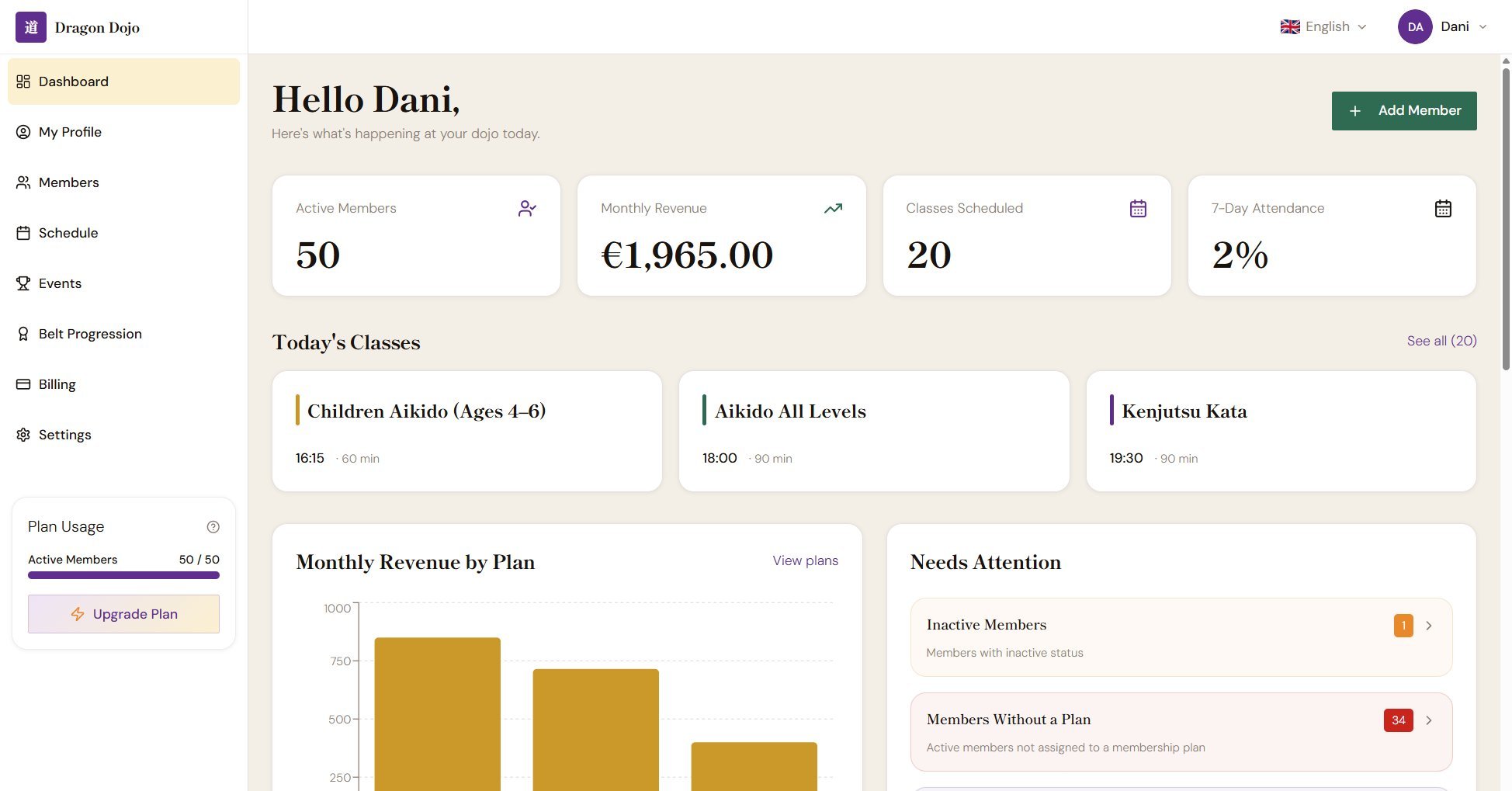
DojoMaster's free plan includes basic scheduling, kiosk check-in, attendance tracking, and belt tracking for up to 20 students. There's no credit card required, no countdown timer, no "upgrade or lose your data" email on day 15. If your school has 20 or fewer active students, you can run on the free plan indefinitely.
DojoTrack's free plan covers up to 50 students but caps you at 10 classes, 25 leads, and 90 days of attendance history. It's a legitimate option for a small timetable, though 90 days of history is shorter than many grading cycles.
The trial trap: A 14-day trial isn't enough to evaluate dojo software properly. You need to enter your students, run a full class cycle, test belt tracking across at least one grading period, and see how parents interact with the system. That takes 4-8 weeks minimum. Any trial shorter than 30 days is designed to create urgency, not informed decisions.

Dojo Management Software Pricing Compared (September 2026)
What Should You Look For in Free Dojo Software?
Fifty-five percent of small businesses plan to accelerate tech adoption in 2026, but 26% cite limited technical expertise as the top barrier (Clutch, 2025). If you're evaluating free dojo software for the first time, simplicity matters as much as features.
Here's what to check before committing:
- Data ownership. Can you export your student data at any time? If the free tier locks your data behind an upgrade wall, it isn't really free — it's a hostage negotiation.
- Upgrade path. What happens when you outgrow the free tier? Is there a paid plan at a price you can afford, or does it jump from $0 to $99/month with nothing in between? DojoMaster's Starter plan at EUR 24/month sits between free and the $69+ competitors charge.
- Martial arts specifics. Does the software understand belts, kyu/dan grades, and time-in-rank requirements? Or is it generic gym software with a "skill tracking" module renamed to "belt tracking"? This distinction matters when you're managing a Karate school with 10 kyu ranks or an Aikido dojo with separate grading for children and adults.
- No credit card required. A free plan that asks for your credit card on signup isn't confident you'll stay voluntarily. The ones that don't ask are the ones built to earn your upgrade through actual value.

Billing and SEPA support are the highest-impact features to evaluate — see our complete guide to dojo payment collection.
Frequently Asked Questions
Is free dojo management software safe for student data?
Reputable free tiers use the same security infrastructure as paid plans. DojoMaster runs on Supabase with row-level security and EU data residency. Gymdesk uses standard cloud encryption. The risk isn't in the free tier itself — it's in using unstructured tools like shared Google Sheets or WhatsApp groups, where student data (including children's information) sits in personal accounts with no access controls. Forty-seven percent of SMBs report SaaS sprawl as a budget problem (Zylo, 2025). Consolidating into one tool, even a free one, is safer than five disconnected apps.
Can I switch from free to paid without losing data?
Yes. DojoMaster keeps all your student data, attendance history, and settings when you upgrade. There's no migration step — you just unlock additional features. The same applies in reverse: if you downgrade, your data stays.
What's the difference between a free tier and a free trial?
A free tier is a permanent plan with feature limitations (like a member cap). You can use it forever. A free trial gives you full access to everything for a limited time (usually 30 days), then requires payment or locks your account. For dojo owners, free tiers let you evaluate software on your own timeline. Free trials create artificial urgency. Among the platforms we compared, only DojoMaster and DojoTrack offer genuine free tiers.
Is DojoMaster's free plan really free for small schools?
Yes. DojoMaster's Free plan covers up to 20 active students with basic scheduling, kiosk check-in, attendance tracking, and belt tracking. No credit card required, no time limit, no "premium feature" popups during your workflow. If your school grows past 20 students, the Starter plan at EUR 24/month (or EUR 19/month billed annually) covers up to 50 students with full scheduling and email communications.
The Bottom Line
Free dojo software works if you have fewer than 20 students and you're OK managing without automated billing and parent communications. For solo instructors just getting started, DojoMaster's free plan or DojoTrack's limited free tier are genuine options — not marketing bait.
But "free" has a cost. At 25+ students, the admin hours you're spending on manual work exceed what paid software charges in subscription fees. At 50 students, you're paying $400/month in hidden labor for something that costs EUR 24/month to automate.
The question isn't whether you can afford dojo software. It's whether you can afford the hours you're losing without it.
DojoMaster starts free for up to 20 students. No credit card, no trial countdown. When you're ready to grow, paid plans start at EUR 24/month. Start free at dojomaster.app.
The Complete Guide to Dojo Management in 2026
Written by Daniil Pavliuchkov, 4th dan Aikido Aikikai and founder of DojoMaster. Sources: First Page Sage, Business Research Insights, Churnkey, Salesforce/Slack, Sage, Vertice, Clutch/BusinessWire, Zylo.