
The gym management software market hit $2.23 billion in 2026 and is growing at 10.24% annually (360iResearch, 2026). That's a lot of money chasing dojo owners. And it shows: pricing pages are vague, tiers are confusing, and add-on fees appear after you've already committed.
I spent three weeks pulling real numbers from eight dojo management platforms. Not the "contact us for a quote" kind. Actual prices from public pricing pages, verified in September 2026. The range might surprise you: on paid plans, a 50-student school pays anywhere from EUR 288 to $2,388 per year depending on the platform.
This article breaks down what each provider charges, what's included, what costs extra, and what you're actually paying per student per month.
Key Takeaways
- Dojo software costs $69–$199/month across major providers for a 50-student school. DojoMaster wins starting at EUR 24/month.
- 77% of IT leaders report unexpected costs after signing a SaaS contract (Zylo, 2026). Watch for add-on fees.
- Per-student cost ranges from EUR 0.48/month (DojoMaster) to $3.98/month (Spark Membership).
- For a starting dojo that runs on under EUR 500 a month, a $99 plan eats a sixth of the budget or more.
→ The Complete Guide to Dojo Management in 2026
What Does Dojo Software Actually Cost Per Month?
Forty-one percent of small business owners report that software costs have increased over the past twelve months (The Small Business Expo, 2025). Dojo management software is no exception. For a school with 50 active students, monthly prices range from EUR 24 to $199 depending on the platform and tier.
The gym management software market reached $2.23 billion in 2026 and is projected to grow at 10.24% CAGR to $4.02 billion by 2032 (360iResearch, 2026). This growth means more options for dojo owners, but also more confusing pricing structures to navigate.
Here's what each platform charges for a 50-student dojo in September 2026:
| Software | Monthly Price (50 students) | Annual Cost | Free Tier |
|---|---|---|---|
| DojoMasterBest value | €24/mo | €288/yr | Yes — Free plan (20 members) |
| Martialytics | $69/mo | $828/yr | 30-day trial |
| Gymdesk | $75/mo | $900/yr | 30-day trial |
| DojoTrack | $95/mo | $1,140/yr | Limited free plan (50 students) |
| Kicksite | $99/mo | $1,188/yr | 30-day trial |
| Zen Planner | $133/mo | $1,596/yr | Not offered |
| Wodify | $199/mo | $2,388/yr | Promotional only |
| Spark Membership | $199/mo | $2,388/yr | 8-week trial |
Sources: vendor pricing pages, September 2026.
A few things stand out. Only DojoMaster and DojoTrack offer a free plan beyond a trial period, and DojoTrack's is capped at 10 classes and 90 days of attendance history. Wodify and Spark both list $199/month but were discounting to $99/month in September 2026 (Wodify as a demo offer, Spark for the first 12 months). Zen Planner's advertised $99/month covers only up to 45 active members; at 50 it's $133/month, or $232/month with the Essentials package.
The pricing models also differ. DojoMaster, Martialytics, Gymdesk, DojoTrack, Kicksite, and Zen Planner scale by student count. That's transparent. You know what you'll pay as you grow. Zen Planner and Wodify also sell feature-based tiers, so a growing school might stay on the same plan but miss functionality they need until they upgrade.

What Hidden Costs Should You Watch For?
Seventy-seven percent of IT leaders experienced unexpected costs after signing a SaaS contract, and 78% reported surprise charges tied to consumption-based or AI features (Zylo 2026 SaaS Management Index, 2026). Dojo software is no different. The monthly price on the pricing page is rarely the full story.
According to the Zylo 2026 SaaS Management Index, 77% of IT leaders experienced unexpected costs after signing a software contract. For dojo owners evaluating management platforms, the sticker price on the pricing page often excludes payment processing markups, branded app fees, and tiered feature gates that inflate the true annual cost.
Three categories of hidden costs show up across providers:
Tiered feature gates
Zen Planner's Studio plan covers billing and scheduling, but a website with lead capture requires the Essentials package ($232/month at 50 members), and marketing automation requires Ultimate ($382/month). Spark Membership has a single all-inclusive plan, but its $99/month promotion lasts 12 months, then the price doubles to $199. The problem? You don't know which features you'll need until you're already onboarded.
Add-on fees
Zen Planner charges $39/month extra for a branded mobile app. A website starts at another $99/month. These aren't luxuries. A branded app and a functional website are baseline expectations for any modern school. At DojoMaster, kiosk check-in, scheduling, belt tracking, email notifications, and events management are included at every tier. No add-ons.
Opaque pricing
Glofox (owned by ABC Fitness) and Xplor Recreation don't publish pricing at all. Estimates place Glofox at $100–$600/month depending on add-ons. When a vendor won't tell you the price before a sales call, that's a signal. What else aren't they telling you?
The real comparison isn't monthly price. It's annual total cost. A platform advertising $99/month that requires a $39/month app add-on and a $99/month website add-on costs $237/month — $2,844/year. Compare that to DojoMaster at EUR 288/year for the same 50-student school. That's nearly a 10x difference.

Payment processing fees are one of the most underestimated costs in this category. For the full breakdown of how dojos collect tuition without losing revenue, see our guide to dojo payment collection.
How Much Are You Actually Paying Per Student?
Small companies with fewer than 20 employees spend an average of $8,000 per full-time employee per year on software, based on analysis of over one million SaaS transactions (Cledara 2025 Software Spend Report, 2025). A solo dojo owner running everything alone should be way below that number across scheduling, payments, email, and management tools.
Per-student cost is the most honest way to compare dojo software. It strips away tiered pricing confusion and shows what you're actually paying for each student the platform manages.
Small businesses with under 20 employees spend an average of $8,000 per full-time employee per year on software (Cledara, 2025). For a solo dojo owner, management software is often the single largest SaaS expense — making per-student cost the clearest way to evaluate true value.
Here's the per-student-per-month math for a 50-student school:
| Software | Monthly Cost (50 students) | Per Student/Month | Annual Per Student |
|---|---|---|---|
| DojoMasterBest value | €24/mo | €0.48 | €5.76 |
| Martialytics | $69/mo | $1.38 | $16.56 |
| Gymdesk | $75/mo | $1.50 | $18.00 |
| DojoTrack | $95/mo | $1.90 | $22.80 |
| Kicksite | $99/mo | $1.98 | $23.76 |
| Zen Planner | $133/mo | $2.66 | $31.92 |
| Spark Membership | $199/mo | $3.98 | $47.76 |
DojoMaster costs EUR 0.48 per student per month. Spark Membership costs $3.98 at its standard rate. That's an 8x difference for functionally similar software: attendance tracking, belt progression, scheduling, and member management.
From my own dojo: Before building DojoMaster, I ran my 40-student Aikido school on Google Sheets plus cash payments. Both tools were free and I had zero costs. But the indirect cost was brutal. I spent 5–6 hours per week on admin: updating attendance, sending payment reminders over email and WhatsApp, tracking belt eligibility. At any reasonable hourly rate, that admin time dwarfed what software would have cost.
What about growth? When your school hits 80 students, here's how costs scale:
| Software | Monthly at 80 Students | Annual Cost |
|---|---|---|
| DojoMaster (Growth)Best value | €59/mo | €708/yr |
| Martialytics | $99/mo | $1,188/yr |
| Gymdesk | $100/mo | $1,200/yr |
| DojoTrack | $95/mo | $1,140/yr |
| Kicksite | $149/mo | $1,788/yr |
| Zen Planner | $189–$288/mo | $2,268–$3,456/yr |
DojoMaster's Growth plan at EUR 59/month covers up to 100 students. Competitors charge $95–$189/month at this range. And remember: if you pay DojoMaster annually, Growth drops to EUR 49/month (EUR 588/year).
Setting your own tuition as the school grows? Read Martial Arts Pricing: One Unlimited Plan or Pricing Tiers?
How Does Software Cost Compare to Total Operating Expenses?
A starting dojo can run on under EUR 500 a month, often just hall rental. An established dojo with a dedicated 24/7 space in a capital city like Berlin runs EUR 4,500–6,500 a month, with rent eating about 80% of it (Cost to Run a Martial Arts School, 2026). For the established dojo, even a $199/month plan is under 5% of the budget. At EUR 500 a month, a $99 plan eats about a sixth of it, while DojoMaster's EUR 24 is under 5%.
A starting dojo can run on under EUR 500 a month, while an established dojo in a capital city like Berlin runs EUR 4,500–6,500. A $99/month software plan is a small line item for the second and about a sixth of the budget for the first. With 41% of small business owners reporting rising software costs (Small Business Expo, 2025), price comparison matters most for the smallest schools.
Here's the question worth asking: is the cheapest option always the right one? Not necessarily. But when two platforms offer the same core features — attendance, scheduling, belt tracking, member management — and one costs 3–8x more, the expensive one needs to justify the gap. Most can't.
SMBs lose 24 working days per year to financial administration alone (Sage, 2025). That's the equivalent of working 13 months but getting paid for 12. The right software doesn't just save you subscription costs. It gives you back hours. Hours you could spend teaching, recruiting, or just being present on the mat.
The math on admin time: If you spend 5 hours per week on manual admin (attendance counting, belt tracking, payment follow-ups), that's 260 hours per year. At even a modest $30/hour for your time, you're losing $7,800 annually to tasks that software automates. The cheapest paid plan on this list costs EUR 288/year. That's a 27x return on investment.

→ 7 Signs Your Dojo Has Outgrown Excel
The Full 2026 Pricing Breakdown
The U.S. martial arts studio industry includes 72,029 businesses generating $21 billion in annual revenue (IBISWorld, 2026). Most are small schools. Here's every major platform compared across the metrics that actually matter: price, free tier, belt tracking, kiosk check-in, and annual discount availability.
| Software | Price (50 students) | Free Tier | Belt Tracking | Kiosk Check-In | Annual Discount |
|---|---|---|---|---|---|
| DojoMasterBest value | €24/mo | Yes (20 members) | Yes | Yes | Yes (€19/mo) |
| Martialytics | $69/mo | No | Yes | Yes | Not advertised |
| Gymdesk | $75/mo | No | Yes | Yes | Not advertised |
| DojoTrack | $95/mo | Limited (50 students) | Yes | Yes | Not advertised |
| Kicksite | $99/mo | No | Yes | Yes | On request |
| Zen Planner | $133/mo | No | Yes | Yes | On request |
| Wodify | $199/mo | No | Limited | Yes | Not advertised |
| Spark Membership | $199/mo | No | Yes | Yes | Not advertised |
Two things you won't find on most pricing pages. First: whether belt progression tracking is purpose-built for martial arts or a generic "skill tracking" module adapted from fitness software. DojoMaster, Martialytics, DojoTrack, and Kicksite are martial-arts-specific. Gymdesk, Zen Planner, Wodify, and Spark serve many gym types, so belt tracking is one module among many. Learn how digital belt tracking actually works →
Second: whether the free tier is permanent or just a trial that expires. DojoMaster's Free plan (up to 20 members) doesn't expire. DojoTrack's free plan covers up to 50 students but is capped at 10 classes and 90 days of attendance history. Everyone else requires a paid subscription once any trial ends.
Wondering whether a free plan is enough? Read Free vs Paid Dojo Management Software.
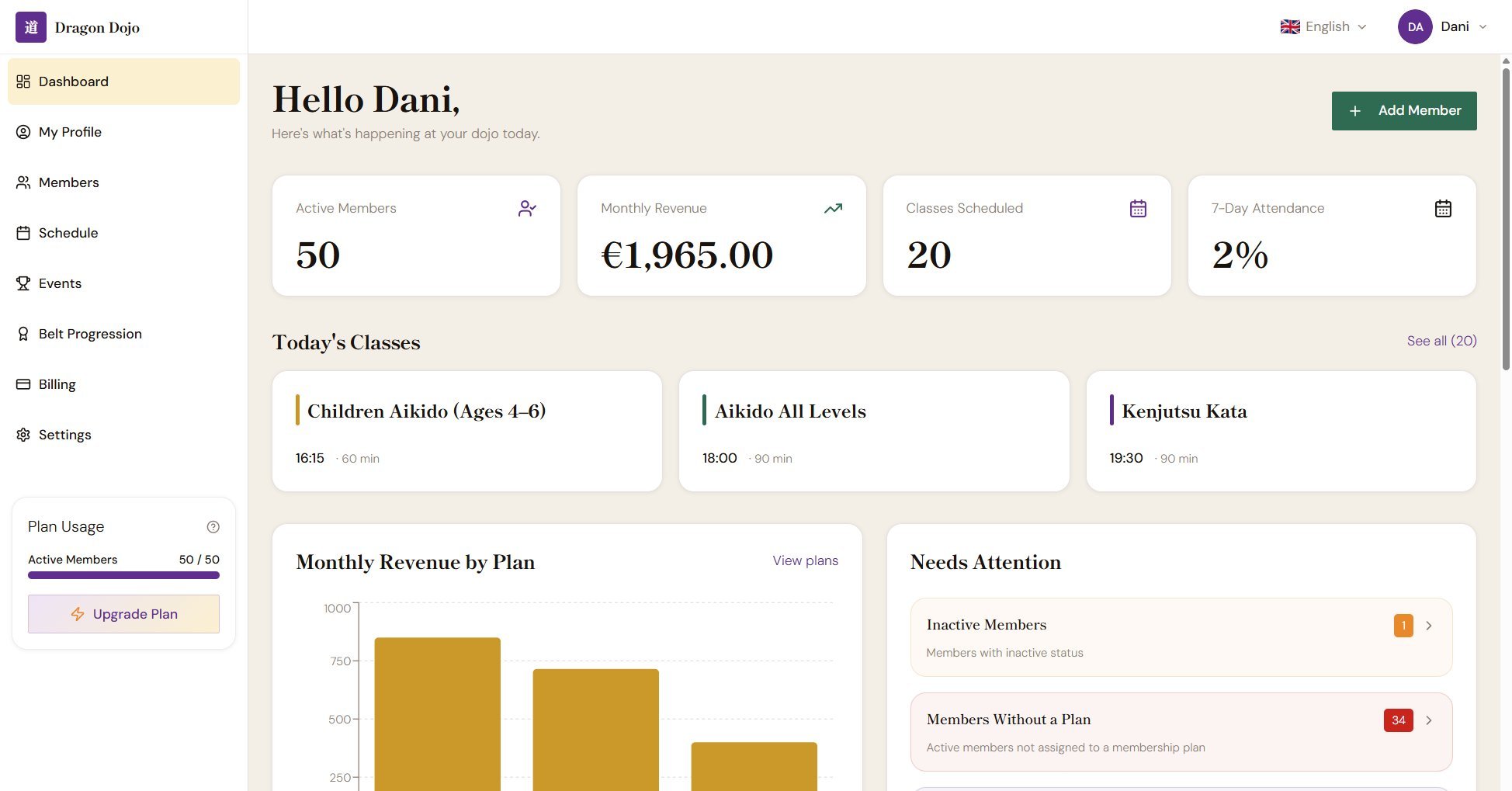
DojoMaster starts free for up to 20 students. Paid plans begin at EUR 24/month (EUR 19/month billed annually). All plans include kiosk check-in, belt progression, scheduling, attendance heatmaps, and email communications. No add-on fees. Start free at dojomaster.app.
Frequently Asked Questions
Is there free dojo management software that actually works?
DojoMaster offers a permanent free tier for schools with up to 20 active members. It includes scheduling, attendance tracking, belt progression, and kiosk check-in. DojoTrack has a free plan for up to 50 students, capped at 10 classes and 90 days of attendance history. Beyond those two, most platforms offer only time-limited trials (30 days to 8 weeks). For schools under 20 students, DojoMaster's free plan covers all core features without any expiry date.
Why is dojo software so expensive compared to other SaaS?
The gym management software market is $2.23 billion and growing at 10.24% annually (360iResearch, 2026). Most platforms target mid-market gyms with 200+ members, pricing accordingly. Dojo-specific tools can charge premiums because the niche is small and switching costs are high. DojoMaster was purpose-built for smaller martial arts schools, which is why its pricing starts at EUR 24/month instead of $99+.
Should I pick software based on price or features?
Both — but features that overlap across platforms aren't differentiators. Every tool on this list offers scheduling, attendance, and member management. The real differences are martial-arts-specific features (belt tracking, exam management, kiosk check-in for kids), pricing model transparency, and hidden fees. Per-student cost is the most honest way to compare: DojoMaster costs EUR 0.48/student/month while the other platforms charge $1.38–$3.98.
Does cheaper software mean worse support?
Not necessarily. Support quality correlates with company focus, not price. A martial-arts-specific platform with 500 schools will understand your belt testing workflow better than a general fitness platform with 10,000 gyms. Most dojo owners don't need enterprise-grade AI features — they need reliable, affordable tools that handle the basics well.
The Bottom Line
The dojo software market spans EUR 24/month to $199/month for a 50-student school. Per-student costs range from EUR 0.48 to $3.98. Some of that gap reflects genuine feature differences. Most of it doesn't.
Before choosing, ask three questions. What's the true annual cost including add-ons? What's the per-student-per-month cost? And does the platform actually understand martial arts, or is it fitness software with a belt tracking tab bolted on?
There are 72,029 martial arts businesses in the United States alone (IBISWorld, 2026). Most are small schools running on tight margins. The median EBITDA margin for fitness operators is 23.6% (HFA, 2025). Every unnecessary dollar in software cost comes directly from that margin.
DojoMaster starts free for up to 20 students. Paid plans from EUR 24/month. No add-ons, no processing markups, no sales calls. Start free at dojomaster.app.
→ The Complete Guide to Dojo Management in 2026
Written by Daniil Pavliuchkov, 4th dan Aikido Aikikai and founder of DojoMaster. Pricing data collected from vendor websites in September 2026. Sources: 360iResearch, Zylo, Cledara, The Small Business Expo, Sage, IBISWorld, HFA.