

Every martial arts school has to decide how to price its classes, and there are really only two ways to do it. You can charge everyone the same, usually for unlimited training. Or you can set up several pricing tiers, based on how often students train or which extras they get.
Tiers often look like the smarter business choice. For most dojos, I'd recommend the opposite: one unlimited plan for everyone, raised a little every year or two. This guide covers both options, the school size where tiers start to pay off, how to raise prices without losing students, and whether fitness passes like ClassPass, Wellhub, or Urban Sports Club belong in your classes.
Key Takeaways
- Pricing comes down to two structures: one plan for everyone, usually unlimited, or tiers based on classes per week or premium extras.
- Under about 20-30 students, one unlimited plan wins. Tiers add rules to enforce for a gain that may be as little as 20 or 30 a month. Revisit at around 50 students.
- Unlimited training lets students grow into the art. Aikikai Hombu Dojo requires 300 practice days from a first class to black belt eligibility, almost six years at one class a week (Aikikai Foundation).
- Raise prices a little every year or two. Consumer prices rose 21.2% in the US and 22.7% in the EU from 2020 to 2024 (BLS via FRED; Eurostat), so a four-year freeze ends in a painful jump.
- Fitness passes bring new people and revenue but pay less per visit, and pass visitors rarely join your community. Whether to join depends on how well your classes can absorb occasional strangers.
This is one piece of a larger topic. For billing mechanics and our survey of adult tuition at 70+ European Aikido dojos, see the dojo owner's guide to payment collection.
What Are Your Pricing Options?
You have two options: one plan for everyone, or several pricing tiers. Neither is automatically right. Each one solves a problem and creates another, so it's worth seeing the trade-offs clearly before you choose.
Option 1: One Plan for Everyone (Usually Unlimited)
One monthly fee covers every class a student is eligible for, and they train as often as the schedule allows. Many schools still charge children and adults different amounts. That's a separate program, not a tier: within each program, everyone is on the same plan.
Pros
- Easy to explain. One sentence on your website, one sentence after a trial class.
- Nothing to police. Nobody checks whether a student has used up their classes this week.
- Room to grow. Students can train more as their interest grows, with no upgrade conversation.
- Equal footing on the mat. Nobody is the "once-a-week member" in front of the group.
- Predictable revenue. The same fee arrives every month, however often people come.
Cons
- Casual students pay the same as regulars. Someone who comes once a week may feel they're paying for the people who come five times.
- A bigger first commitment. A nervous beginner sees one price and no cheaper way in.
- No premium revenue. Students who'd happily pay more for extras have nothing extra to buy.
- Busy classes get busier. If a popular time slot is already full, frequent trainers fill it further without paying more.
Option 2: Several Pricing Tiers
Tiers split students by what they get. The conditions usually come in two kinds:
- Training frequency: one class a week, two classes a week, unlimited.
- Premium extras: free equipment such as a gi or sparring gear, free entry to seminars, access to special classes like weapons, a competition team, or open mat, or a regular private lesson.
Pros
- A cheaper way in for students who can only come once a week.
- Extra revenue from committed students who value the extras.
- Visible rewards for long-term students through perks.
- A better match for big schedules in large schools that run several programs, such as kids' and adult classes or a competition team.
Cons
- Constant tracking. Someone has to know who came, how often, and which classes each plan allows.
- Awkward moments at the door. Every limit eventually needs enforcing, usually five minutes before class.
- A cap becomes a ceiling. A plan that allows one class a week quietly becomes the student's pace.
- More to explain. Every prospect has to compare options before they can say yes.
- Downgrades. Students can move down a tier as easily as up.
| What matters | One unlimited plan | Pricing tiers |
|---|---|---|
| Weekly admin work | Almost none | Track visits and enforce limits |
| Explaining it to a new student | One sentence | A comparison of options |
| Entry price for once-a-week students | Same as everyone | Lower |
| Extra revenue from committed students | None beyond the base fee | Premium plans and perks |
| Training more before a grading or competition | Just come to more classes | Only after an upgrade |
| Best fit | Most schools, especially under 50 students | Schools with 50-100+ students, daily classes, and several programs |
Why Pricing Tiers Rarely Pay Off in a Small Dojo
If your school has up to 20 or 30 students, one plan is usually the better deal, because tiers add work for very little money.
The work is easy to underestimate. Picture a student on a twice-a-week plan who turns up for a third class this week. Do you let them in? Do you say something tonight, or let it slide? And what if they do it every week? Each of those questions lands on the owner, and none of them appears on the price list.
From my own dojo: I kept attendance for my Aikido classes in Google Sheets for two years, and just counting who came was a Sunday-evening job. Put a weekly allowance on each student, and every row in that sheet becomes a rule to check, and sometimes a conversation to have.
What Tiers Actually Earn a Small School
Here's an illustrative example, not survey data: a 25-student school charging 120 a month. The math works the same in dollars or euros. The owner adds a twice-a-week plan at 105 and raises the unlimited plan to 130.
| Setup | Students | Monthly fee | Monthly revenue |
|---|---|---|---|
| Before: one unlimited plan | 25 | 120 | 3,000 |
| After: new twice-a-week plan | 9 | 105 | 945 |
| After: unlimited plan, raised | 16 | 130 | 2,080 |
| After: total | 25 | - | 3,025 (+25) |
Nine students who mostly come twice a week anyway move to the cheaper plan. Sixteen stay unlimited at the higher price. The school gains 25 a month. That's before a single student decides the price rise is a reason to leave, and before anyone counts the hours spent matching visits to plans.
Change the assumptions and the result moves a little, but at this size it rarely adds up to much: there aren't enough students to split. The checking doesn't shrink with the school, though. Someone still has to compare every visit with every plan, and in a small dojo that someone is you. Schools under 30 students can often get by with tidy spreadsheets and a group chat (the complete guide to dojo management). A pricing model that needs constant checking works against that.
What an Unlimited Plan Does for Student Progress
An unlimited plan lets each student's training grow with their commitment. In martial arts, that matters, because progress is built from accumulated time on the mat.
Think about how a student actually changes. Someone unsure about the art starts with one class a week. A few months in, they want a second class, and with an unlimited plan they simply come. Before a competition or a grading, the same student might train three or four times a week for a while. Unlimited allows that too, with no upgrade form and no extra invoice.
A frequency cap works the other way. "I can only train once a week" starts as a line on the price list and turns into the student's pace. Stretched over years, that can stall their progress.
Grading Requirements Show What a Cap Costs
Grading systems make this concrete. At the Aikikai Hombu Dojo in Tokyo, eligibility for the kyu grades and 1st dan is counted in practice days: 30 days for 5th kyu, then 40, 50, 50, and 60 days between the kyu grades, and 70 more after 1st kyu before 1st dan (Aikikai Foundation). That's 300 practice days from a first class to black belt eligibility. At one class a week, it takes almost six years. At three a week, it takes under two.
Beginners need frequency early, too. The training habit forms through repetition in the first weeks, and a once-a-week cap works against that by design (see the 90-day dropout window). Tying readiness to attendance, not just time, is also what makes belt progression work as a retention tool.
Pricing for a Long Relationship
There's a deeper reason as well. A martial art passes from teacher to student over years, not class by class, so the goal of your pricing is a long relationship with each student. Community is what turns a beginner into a ten-year student (the student retention guide), and a group is easier to build when nobody on the mat is rationing their visits.
My recommendation: for most martial arts schools, one unlimited plan for everyone. Revisit that decision when your school grows to around 50 students across different levels.
When Do Pricing Tiers Start to Make Sense?
Pricing tiers become worth a serious look once a school passes about 50 students, and especially past 100, with classes every day across several programs.
At that size the picture changes. You might run kids' BJJ, adult BJJ, a competition team, and special weapons classes on one weekly schedule. Students use the school in genuinely different ways, and small differences per student add up across a large roster.

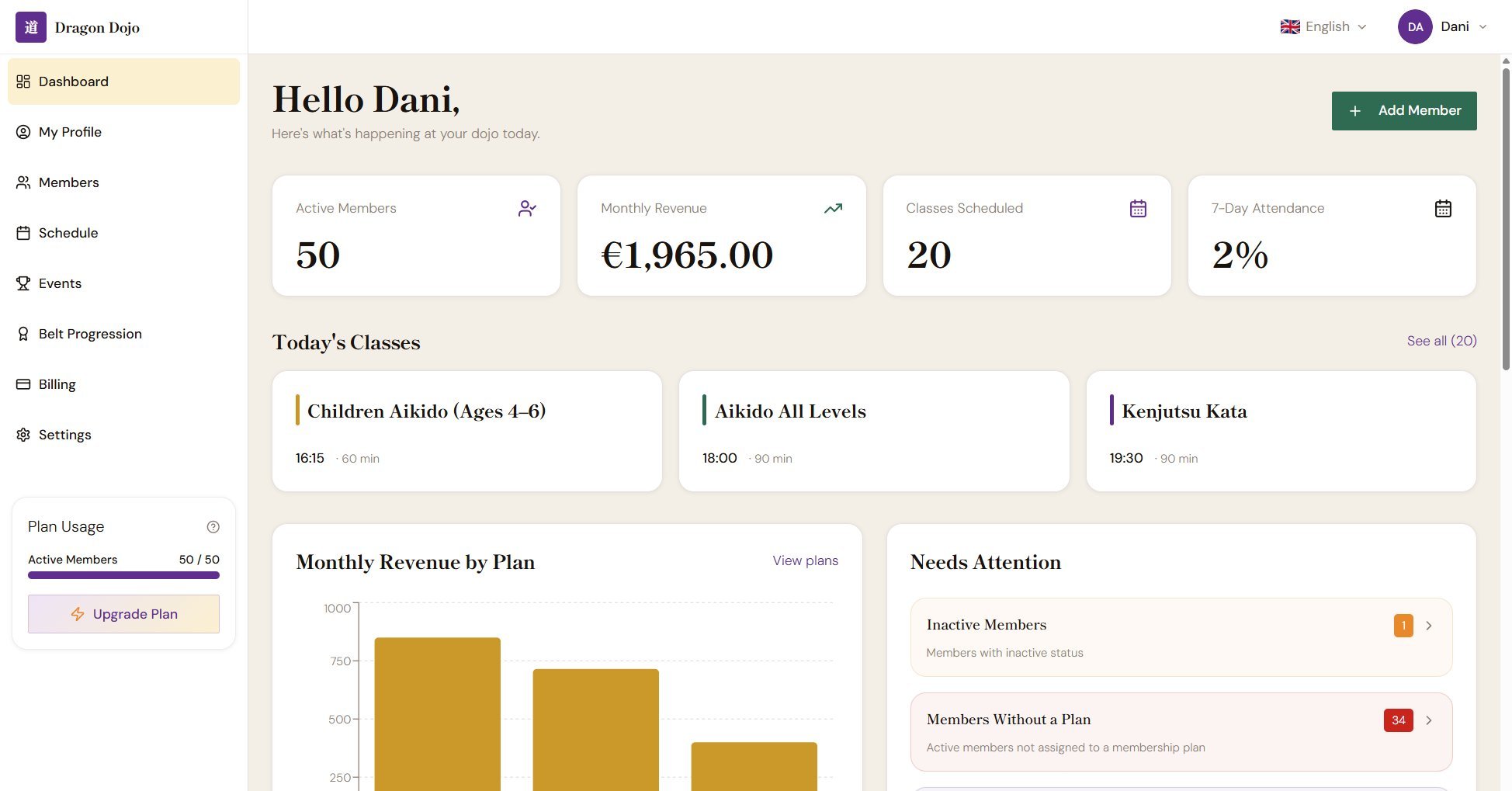
The admin problem also mostly takes care of itself. A school this size usually has front-desk staff, a manager, or software that tracks attendance, so matching visits to plans no longer lands on the owner. DojoMaster, for example, records every check-in automatically, whether a student finds their name at the kiosk, enters a PIN, or scans a QR code, and each student's profile shows how many classes they attended week by week. For the wider set of options, see manual vs. automated attendance tracking.
How to Set Up Tiers When You're Ready
- Keep an unlimited plan at the center. Build tiers around it, not instead of it, so a student who wants to train more always has a simple way to do it.
- Prefer perks you don't have to police. Seminar entry or free equipment is handled once, and access to a special class is a simple yes or no. A weekly class count has to be checked at every visit.
- Stop at two or three options. Beyond that, prospects spend their trial class comparing plans instead of thinking about training.
- Make upgrading instant. A student preparing for a grading or a competition should be able to move up the same day.
- Decide the over-the-limit rule before anyone hits it. For example, an occasional extra class is fine, and a steady pattern means a friendly conversation about upgrading.
- Review attendance monthly, not at the door. Patterns tell you far more than any single extra class.
Which Setup Fits Your School?
| School size | What it usually looks like | Pricing I'd recommend |
|---|---|---|
| Up to 20-30 students | Owner teaches all classes, a few classes a week, the owner does the admin | One unlimited plan, raised in small steps |
| 30-50 students | A growing schedule, 1-2 junior instructors, the owner still handles most of the admin | Still one plan. Start tracking attendance so you know how students actually train |
| 50-100+ students | Daily classes, several programs, staff or software handling admin | Consider two or three tiers built around an unlimited plan |
How to Raise Prices Without Shocking Your Students
Raise prices by a small amount every year or two, not by 20-30% after years of standing still. Over four to six years you end up at the same price, and you lose fewer students getting there.
The Four-Year Freeze Trap
Many clubs hold one price for as long as they possibly can, afraid that any increase will send students away. Meanwhile rent, electricity, and equipment keep getting more expensive. Eventually the numbers force a 20 or 30% increase all at once, and students experience it as a shock.
Those figures aren't dramatic. They're arithmetic. From 2020 to 2024, consumer prices rose 21.2% in the US, based on annual CPI-U averages from the Bureau of Labor Statistics (BLS via FRED). Across the EU they rose 22.7%, compounding Eurostat's annual HICP inflation rates for 2021-2024 (Eurostat). A fee frozen at 100 in 2020 was worth about 82 in real terms by 2024. Almost a fifth of the price disappeared without anyone noticing.
From my experience: an owner who has frozen prices for four years usually tries to explain the jump: we kept tuition low for four years, so this makes up for that time. It's true, and it almost never lands. Students don't run that calculation in their heads. They compare the new price with the one they paid last month. That's why a big jump every few years is such a bad strategy.
Why a Big Jump Feels Unfair and a Small One Doesn't
Research on how people judge prices explains the reaction. In a classic fairness study, Daniel Kahneman, Jack Knetsch, and Richard Thaler found that people judge a price change against a reference transaction: for an existing customer, usually the last price they paid (American Economic Review, 1986). Their telephone surveys in Toronto and Vancouver also showed how much the reason matters. 75% of respondents found it acceptable for a landlord to raise the rent at renewal to cover substantially higher costs, even for a tenant on a fixed income (N=151). But 82% called it unfair for a hardware store to raise snow-shovel prices the morning after a snowstorm (N=107).
The study didn't compare small and large increases directly, but it helps explain why small steps work. A modest increase tied to this year's costs looks like the landlord passing on real expenses. A 25% jump asks students to absorb four years of costs they never saw, measured against last month's price.
Price is also the reason people give most often for quitting a gym. In YouGov data published in 2024, 41% of former gym-goers in the US said they cancelled because their membership was too expensive (YouGov, 2024). A sudden jump hands a wavering student the most common exit line there is.
Small Steps: Same Destination, Smoother Road
Both paths end at 125. On the first, students pay the same fee for four years and then absorb a 25% increase in a single letter. On the second, the fee rises by 5 each year, about 4-5% a step, which is roughly the average yearly inflation of 2021-2024 in both markets. Nobody gets a shock, and every step has an honest, current reason: this year's rent, this year's electricity bill.
The gradual path also collects more along the way. Add up the monthly fee in each of the five years and the small steps come to 575, against 525 for the freeze. At twelve months a year, that's 600 more per student over five years, or 24,000 from a 40-student school, with no dramatic announcement at all.
In practice, a small step means something like $5 on a US plan, or a few euros on a European one, where typical adult tuition in our survey of Aikido dojos sat between €33 and €65 a month. A step that size is unlikely to scare anyone away. Everyone knows that rent, electricity, and equipment get more expensive every year.
How to Announce a Price Increase
- Check your contracts first. What you can change depends on your membership terms and local consumer law. In Germany, for example, fees on a running contract can only go up under a valid price-adjustment clause or with the member's consent; otherwise the old price stays (Verbraucherzentrale, 2026). In the US, start with your membership agreement and state rules.
- Pick a fixed rhythm. Use the same month every year or every second year, for example the start of the season, so an increase becomes routine rather than an event.
- Give at least a month's notice. Students should never learn about a new price from their bank statement.
- Name the actual cost. This year's rent, the electricity bill, new mats. A concrete cost is the kind of reason most people accept as fair.
- Tell long-time students in person first. A word after class does more than any email.
- Keep one price for everyone. With steps this small, you rarely need grandfathering rules that leave you with several prices for the same class.
Message Examples: Matter-of-Fact vs. Loaded
Matter-of-fact (use these):
- "Quick heads-up: from January 1, monthly tuition goes from $150 to $155. Our rent and electricity went up again this year. Thank you for training with us!"
- "From September, membership will be €52 a month instead of €50. We adjust prices a little each year so we never have to make a big jump. Questions? Grab me after class."
- "Every year we review our costs, and this year the rent went up. Starting March 1, the unlimited plan costs $5 more per month. Same classes, same schedule, same people."
- In person, before the email goes out: "Before you read it in the email: tuition goes up by €2 from March. Rent went up again, and I wanted you to hear it from me first."
Loaded and worth avoiding:
- "Due to four years of rising costs, we are forced to raise tuition by 25%, effective next month." (a big jump on short notice, framed as payback for the past)
- "We've kept prices low for years out of goodwill. It's time everyone paid their fair share." (guilt instead of a reason)
- "Unfortunately, current economic conditions have made an adjustment necessary. We apologize for any inconvenience." (vague, corporate, and no actual reason)
- A higher amount on the next invoice with no message at all. (the surprise does more damage than the money)
Should Your Dojo Join ClassPass, Wellhub, or Urban Sports Club?
Fitness-pass programs can bring you new people and new revenue, but pass visitors rarely become part of your community. Whether that trade is worth it depends on how well your classes can absorb occasional strangers.
How Fitness Passes Work
These programs sell one subscription that opens the door to many venues across a city. A member might drop into a different place once a week: yoga one week, then badminton, basketball, or football, then an Aikido class. Employers often pay for the pass as a staff benefit, and plenty of people buy it for themselves.
Germany is the world's largest aggregator market, according to the German daily taz. Its biggest player, Urban Sports Club, has more than 15,000 partner locations in eight countries. The most popular Classic plan costs €75 a month and lets members check in once a day, but only four times at the same studio. Some 11,000 companies offer it to their staff, and more than half of its members came through an employer even before Wellhub bought the company for $600 million in March 2025 (taz, 2026).
In the US, similar programs include ClassPass and Wellhub, the corporate wellness platform formerly called Gympass (Athletech News, 2024).

What Your School Can Gain
- Revenue from people who'd never have found you. Pass members browse everything their city offers, not just martial arts.
- A steady supply of first classes. Someone who tries Aikido on a whim may discover it's exactly their thing.
- A relationship you can build on. Every visitor is a chance to turn a stranger into a regular student with a direct membership.
What It Can Cost You
- Less money per visit. Payouts are confidential, but industry estimates reported by taz put Urban Sports Club's payouts 50-65% below what a direct booking earns, a figure taz notes can't be verified. A company spokesperson confirmed that a member's first visit to a studio isn't paid at all (taz, 2026). In New York, one yoga studio charged $25 for a drop-in class while ClassPass paid it $8 per class (Vice, 2020).
- Your own members may switch. The same studio's owner said regulars had moved to the pass "because it's literally cheaper" (Vice, 2020).
- Strangers in the room. A visitor who comes when they're in the mood for Aikido, once, twice, three weeks in a row, never really joins the group. They don't get to feel the strength of your community, and they usually stay strangers.
- Group dynamics. A class that works because everyone knows each other can lose its rhythm when unfamiliar faces keep rotating through. In partner arts, your students also end up training with someone whose level and control they don't know.
- Dependence. Some newer studios report getting up to 90% of their participants through aggregators (taz, 2026). Once most of your students arrive through a platform, its terms become your terms.
| What matters | Join a fitness-pass program | Direct memberships only |
|---|---|---|
| New people trying your classes | Steady flow from the platform | Only through your own marketing |
| Revenue per visit | Below your direct price | Your full price |
| Group dynamics | Needs structure to absorb visitors | Stable group |
| Long-term relationships | Only with visitors you convert | The default |
| Dependence on a platform | Grows as more students arrive through it | None |
How to Decide
This is a business decision, and both answers can work. What matters is whether you have the infrastructure and class structure, including senior students who can take a visitor under their wing, so that an occasional stranger doesn't break the group's dynamics. If you do, a fitness pass can add revenue and bring in new students.
If your classes depend on a close-knit group, or drop-in visitors run against how you want to teach, turning these programs down is just as valid. Martial arts are built on long-term relationships, and declining city-wide pass contracts for that reason is a legitimate choice.
Whichever path you choose, you can make it work. Just go in knowing the upside, the downside, and the risks.
If you do join:
- Ask which classes you can open to pass members, and how many spots, before you sign. Keep advanced and sparring classes for your own students.
- Pair each visitor with a senior student for partner work.
- Invite regular visitors to join properly, in person, after a few classes. Explain what membership gives them that a pass can't: a steady group, a teacher who follows their progress, and a path to grading.
- Watch for members switching to the pass. If your own students start training on it because it's cheaper, the program is costing you money.
- Review after three to six months. How many visitors became members, and how did your regular group feel about the change?
Frequently Asked Questions
Should a small martial arts school offer pricing tiers?
Usually not. Under about 20 to 30 students, one unlimited plan is simpler to run, and tiers mostly add rules to track and enforce for a gain that may be as small as 20 or 30 a month. Revisit the question once the school reaches around 50 students with daily classes and staff or software that tracks attendance.
How often should a dojo raise its prices?
Every year or two, in small steps. Consumer prices rose 21.2% in the US and 22.7% in the EU from 2020 to 2024 (BLS; Eurostat), so a school that freezes tuition for four years ends up needing a 20 to 30% jump, which students experience as a shock.
How much notice should I give before raising membership prices?
At least a month, and never as a surprise on an invoice. Check your membership terms first: in Germany, for example, fees on a running contract can only rise under a valid price-adjustment clause or with the member's consent (Verbraucherzentrale, 2026).
Is joining ClassPass or Urban Sports Club worth it for a martial arts school?
It can be, if your classes can absorb occasional visitors. Passes bring new people and extra revenue, but they pay less per visit than a direct membership, and visitors who come only when they feel like it rarely become part of the group. Decide based on your class structure and how you want to teach.
Can a one-plan school still offer a family discount?
Yes. A family or sibling discount is set once, when the family signs up, so it doesn't need weekly tracking the way frequency tiers do. It fits a one-plan school without bringing back the admin work that tiers create.
Start free at dojomaster.app for up to 20 students, with paid plans from EUR 24/month.
Written by Daniil Pavliuchkov, 4th dan Aikido Aikikai and founder of DojoMaster. Sources: Aikikai Foundation, U.S. Bureau of Labor Statistics CPI-U via FRED, Eurostat, Kahneman, Knetsch & Thaler, American Economic Review (1986), YouGov, Verbraucherzentrale, taz, Vice, Athletech News.