

Most small dojos do not choose a billing system. They inherit one: cash in an envelope at the front desk, a bank transfer some students remember and some do not, and a spreadsheet that only the owner understands.
It works at 15 students. At 60 it quietly starts costing money, and the cost shows up in three places at once: the processing fees you pay, the dues that silently fail, and the hours somebody spends chasing them.
This guide walks through setting up recurring membership billing from scratch, with the US and European paths side by side at every step. Europe matters here because the cheapest, most reliable option for a European dojo -- SEPA Direct Debit -- is missing from essentially every other guide on this topic.
Key Takeaways
- Collecting an illustrative 80-unit monthly membership from 100 students costs about $3,144 a year on US cards versus $768 on ACH debit, and EUR 1,740 on European cards versus EUR 420 on SEPA Direct Debit, calculated from published processor rates (Stripe US, Stripe Ireland, retrieved 2026-09-19).
- Bank debit does not just cost less, it fails less. Around 7-12% of monthly fitness membership dues fail to process (ABC Fitness, 2026), against 2.2% for direct debits overall and 1.5% for membership organizations (GoCardless, retrieved 2026-09-19). These figures count different things, so read the gap as several times over, not as a like-for-like ratio.
- European members do not have to approve a payment every month, on either rail. A SEPA debit is initiated by you, not the member, so Strong Customer Authentication does not attach to the collection at all; authentication belongs at mandate setup. For recurring card payments, SCA applies when the series is created, amended, or first initiated, and the payments that follow are exempt (Commission Delegated Regulation (EU) 2018/389, Article 14).
- Keep the monthly amount fixed anyway. On cards it is what preserves that "same amount, same payee" exemption; on SEPA it is what keeps pre-notification and reconciliation simple.
- Roughly 25% of lapsed subscriptions are purely a payment failure, not a decision to quit (Stripe, 2024). Plan your retry and follow-up process before you launch, not after the first month goes wrong.
This guide covers the mechanics of setting billing up. For the wider picture of how dojos collect money, what to charge, and how to protect revenue, see the full guide to payment collection for dojo owners, and for where billing sits in the rest of the admin stack, the complete guide to dojo management.
Before You Start: What You Need in Place
Recurring billing is not the first thing to fix. It is the thing that breaks loudest if the fundamentals underneath it are vague.
What you need before you touch a payment processor:
- A fixed monthly price per membership type. Not a range, not "it depends." If you have not settled this, settle it first.
- A written start date, notice period, and pause policy. Every one of these becomes a billing rule, and inventing them mid-cycle is how disputes start.
- A current member list with real contact details. Migration failures are almost always data failures.
- A business bank account in the country where you operate, and a legal entity that matches it.
- A decision about one-off charges -- grading fees, seminars, gear -- because these are handled separately from the recurring series. More on that in Step 4.
Time: about a day of setup, plus one billing cycle of supervision. Difficulty: beginner, with one genuinely technical decision (Step 1).
Step 1: Pick Your Billing Rail
By the end of this step you will have chosen how money actually moves: card, or direct from the bank account.
This is the decision with the largest financial consequence in the whole guide, and most schools make it by default rather than on purpose. There are three realistic rails for a small school, and which ones are available depends on where your members bank.
Cost figures are Stripe's published list prices for the US and Ireland, retrieved 2026-09-19; they are representative of the market rather than universal, and your own processor's numbers may differ. The reliability column draws on GoCardless (direct debit, retrieved 2026-09-19) and Nacha (ACH returns); the 1.5% figure is for direct debit to membership organizations generally, not for SEPA specifically.
What the Difference Actually Costs
Take an illustrative membership of 80 per month (there is no reliable published average tuition figure for martial arts schools in either market, so treat 80 as a round number for the arithmetic, not a benchmark). At 100 students, the rail you pick changes your annual processing bill by more than the price of a new mat.

Why European Card Processing Is Cheaper Than American
European dojo owners sometimes assume the US figures they read online apply to them. They do not, and the reason is regulatory rather than commercial. EU law caps interchange -- the portion of a card fee that goes to the cardholder's bank -- at 0.2% for consumer debit cards and 0.3% for consumer credit cards, a rule in force since December 2015 (Regulation (EU) 2015/751, Articles 3 and 4).
The US has no equivalent blanket cap. Regulation II caps debit interchange for large issuers only, and the Federal Reserve's CY2024 data shows the gap that creates: covered transactions averaged $0.23 on a $48.95 ticket, while exempt-issuer transactions averaged $0.51 on a smaller $42.27 ticket (Federal Reserve, published December 2025).
Verification: you have picked a rail when you can say which one every single member will be on, and what you will do about the members who cannot use it (an international student with no euro account, for instance). Most schools end up with a primary rail and a card fallback.
Step 2: Collect the Right Authorization
By the end of this step, every member will have given you permission to charge them, in the form the rail actually requires.

The three rails need three different things, and treating them as interchangeable is the most common setup mistake:
- Card on file: the member enters card details once through your processor's hosted form. Never type a card number into your own spreadsheet, email, or booking notes.
- ACH Direct Debit (US): you need the member's bank routing and account number plus a recorded authorization, and the form of that authorization is regulated. Preauthorized transfers from a consumer's account "may be authorized only by a writing signed or similarly authenticated by the consumer," and whoever obtains the authorization "shall provide a copy to the consumer" (Regulation E, 12 CFR 1005.10(b)). Your processor supplies compliant wording; use theirs rather than writing your own.
- SEPA Direct Debit (EU): you need a mandate -- a specific, documented authorization that identifies you as creditor and carries a unique mandate reference. It is a distinct legal artifact, not a checkbox. The full walkthrough of SEPA mandates for dojo owners covers what has to be on one.
The European objection you will hear, and the answer. Owners often assume SEPA means asking members to confirm a payment every month. It does not, and the reason is worth getting right, because it differs by rail.
A SEPA Direct Debit is initiated by you, the creditor, not by the member. Strong Customer Authentication under PSD2 is an obligation on payer-initiated transactions, so it does not attach to the individual collections at all. Authentication belongs at the point the mandate is set up, and after that the mandate simply runs.
For members paying by card rather than SEPA, a different rule gets you to the same place. SCA is required when the payer "creates, amends or initiates for the first time" a series of recurring transactions of the same amount to the same payee, and every subsequent payment in that series is exempt (Commission Delegated Regulation (EU) 2018/389, Article 14, applicable since September 2019). You authenticate once, at signup, and the series runs from there.
Verification: you can produce, for any member, the dated record of what they authorized and the reference that ties it to their payments. If you cannot, you do not have an authorization, you have an assumption.
Step 3: Set the Schedule and Pre-Notify
By the end of this step, money leaves member accounts on a date they knew about in advance.
Pick one collection date for the whole school, not each member's personal join anniversary. A single date means one reconciliation, one retry window, and one follow-up batch. Per-member dates mean billing admin every day of the month, which is precisely the work you are automating away.
Then handle the joining month explicitly. Either pro-rate the first partial month or start the recurring series on the 1st of the next month and take the partial period as a one-off charge. Both are fine. Leaving it undefined is not, because it guarantees an awkward conversation with your newest student.
European schools have a hard requirement here. The SEPA scheme requires the creditor to send a pre-notification to the debtor ahead of each collection, with the standard rulebook timeline being at the latest 14 calendar days before the due date unless you and the member agree otherwise (European Payments Council SDD Core Rulebook). In practice a fixed monthly amount on a fixed date is usually covered by a single notice at signup, but the obligation is real and worth configuring rather than assuming.

Announcing the Switch: What to Say and What Not To
Moving an existing school onto automatic billing is a communication problem as much as a technical one. The same change reads as either "this is now easier for you" or "the dojo is getting corporate," depending entirely on wording.
Say it like this:
- "From 1 November, membership dues will be collected automatically on the 1st of each month. Same amount, same price, no more remembering bank transfers. Set it up here: [link]."
- "We are moving to automatic monthly payments so nobody has to chase anybody. You will get a reminder before each collection, and you can cancel any time with [X] weeks notice, exactly as now."
- "Quick admin note: dues move to direct debit from November. It takes two minutes to set up and means no more cash at the desk on a busy Tuesday."
Not like this:
- "All members are required to enroll in automatic payment. Failure to do so by 1 November will result in suspension of training privileges." (Threat-first framing over a routine administrative change.)
- "Due to ongoing problems with late and missed payments, we are introducing mandatory direct debit." (Blames the whole school for a handful of cases, and tells your best-paying members they are under suspicion.)
- "We are switching to a new payment system. Please fill in the attached form and return it to the office." (No date, no reason, no link, and a paper step nobody will complete.)
Verification: run one cycle and reconcile it by hand. If every expected collection appears, on the expected date, for the expected amount, the schedule is correct.
Step 4: Handle One-Off Charges Without Breaking the Series
By the end of this step, grading fees and seminars are billed without disturbing the monthly membership.
This is the step most guides skip, and it has a real consequence on both rails.
For members on card, the exemption described in Step 2 depends on the series being the same amount to the same payee. Add a grading fee to November's collection and that month falls outside the exemption, so the member may be asked to authenticate again.
For members on SEPA, nothing re-authenticates, but a changed amount is still not free: the scheme expects the member to be pre-notified of what you are about to collect, so varying the figure means varying the notice too. On both rails, a membership line that is the same number every month is also the one a parent can check at a glance.
The fix is structural, not clever:
- Keep the recurring membership amount fixed. Forever, until you actually change the price.
- Bill one-off charges as separate transactions, on their own date, with their own description. Grading fees, seminar tickets, gear, camp deposits.
- Announce variable charges before they land. A $50 or EUR 45 grading fee appearing unexplained in a bank statement generates more front-desk conversation than it saves.
If you charge per class rather than a flat monthly rate, recurring billing will never settle down, because the amount changes every cycle by design. That is a pricing decision with a billing consequence, and it is worth making deliberately.
Verification: your recurring collection is the same figure every month, and every grading fee or seminar ticket appears as its own line with its own date.
Step 5: Plan for Failures Before They Happen
By the end of this step you have a written answer to "what happens when a payment does not go through."
Some payments will fail. This is not a sign you chose badly, it is the base rate of the mechanism.
A note on those numbers, because the difference matters: "dues that fail to process" counts card declines, expiries and gateway errors; a "direct debit failure rate" counts returned debits; and Nacha's 1.42% is a network-wide return rate for 2013, published as the baseline when it set its current return-rate thresholds. They are not the same measurement, and the ACH figure is old. What they consistently show is a gap of several times between card-led and bank-debit collection, not a precise ratio.
What to configure before you launch:
- Automatic retries with a few days' gap, not an instant re-charge. Retried direct debits succeed more than 75% of the time (GoCardless, retrieved 2026-09-19).
- A card-expiry warning ahead of the billing date, since an expired card is the one failure you can prevent entirely.
- A separate log for billing failures and cancellations. If both land in the same column, you cannot tell whether six members left or four left and two cards expired. Around 25% of lapsed subscriptions are payment failures rather than decisions (Stripe, 2024), which is also why some apparent retention decline is really an unfixed payment method.
What Members Can Stop or Reverse, and When
Both markets let the payer push back on a bank debit, but through different mechanisms, and the difference shapes how you design notice periods.
Sources: Deutsche Bundesbank for the SEPA windows; Regulation E, 12 CFR 1005.10(c) and 1005.11 for the US, where an unauthorized electronic fund transfer counts as an "error" the consumer may assert by notice "received by the institution no later than 60 days after the institution sends the periodic statement."
The two systems are not equivalent, and the difference is conditionality rather than length. In the euro area a member can reverse any SDD Core collection for eight weeks without giving a reason at all. In the US there is no comparable unconditional right: a member who authorized the debit must either tell their bank to stop it at least three business days before the date, or assert that the transfer was unauthorized within 60 days of the statement. Disputing a charge you were entitled to collect is not the same as claiming it was never authorized.
The practical advice lands in the same place in both markets even though the mechanism differs. Design your notice period so the last collection is never a surprise, because in Europe an unhappy member can simply undo it, and in the US an unhappy member can stop the next one.
From my own dojo: when I was running a 40-student Aikido school on Google Sheets and Stripe invoices, I told myself the billing admin was maybe an hour a month. It was not. It was ten minutes here and twenty minutes there, every week, plus the part I never counted at all: the low-grade reluctance to message a parent about money, which meant some invoices sat unsent for weeks. The switch that actually helped was not a better spreadsheet. It was making the collection automatic so there was nothing to feel awkward about.
Verification: you can state, without looking it up, what happens automatically when a payment fails, on what day the member hears from you, and where that failure is recorded so it never gets counted as a cancellation.
Step 6: Keep It Compliant
By the end of this step you can answer a member who asks "where are my bank details stored?"
- Never store card numbers yourself. Use your processor's hosted fields so card data does not touch your systems. This is also what keeps you in the lightest PCI DSS self-assessment category. Note that SAQ A changed in January 2025: three requirements were removed from the questionnaire and replaced with an eligibility criterion that your e-commerce pages are not susceptible to script-based attacks (PCI Security Standards Council, January 2025).
- US schools: keep the signed authorization, and give the member a copy. Both halves are required by Regulation E, not merely good practice (see Step 2). If a member later disputes a debit, that record is what you have.
- US schools: expect and respect stop-payment requests. The duty to act on one falls on the member's bank, not on you: a member can stop a scheduled transfer by telling their bank at least three business days before the date (12 CFR 1005.10(c)). Cancel your side too, rather than re-presenting a payment the member has already stopped.
- Treat mandates and bank details as personal data. For European schools that means a lawful basis, a retention period, and the ability to produce or delete a member's records on request under the GDPR.
- Keep the mandate or authorization reference with the member record, not in a separate file that only you can find.
- Watch the incoming EU payments reform. A provisional political agreement on PSD3 and the Payment Services Regulation was reached in November 2025. Under the agreed text, authentication is expected to be required at mandate setup rather than on each merchant-initiated transaction. Merchant-initiated payments are also set to be aligned with direct debits on consumer protections, including refunds (Norton Rose Fulbright, 2026). None of this is law yet and the timetable is still moving, so treat it as direction of travel rather than a deadline.
Verification: for any member, you can produce their authorization or mandate, its reference, and the date it was given, and you can say where that record lives and how long you keep it.
Common Mistakes to Avoid
1. Running two systems in parallel "for now." Half the school on direct debit and half still paying cash is not a transition, it is permanent double bookkeeping. Set a switchover date and move everyone.
2. Letting members choose their own collection date. It feels accommodating. It converts one monthly reconciliation into thirty, and it is the single fastest way to make automated billing feel like manual billing with extra steps.
3. Varying the monthly amount. Adding grading fees or gear to the membership collection breaks the same-amount condition behind the card authentication exemption, changes what a SEPA member has to be pre-notified of, and makes every statement line harder for parents to check. Bill extras separately.
4. Treating a failed payment as a resignation. It usually is not, and reacting as though it is turns an expired card into an awkward conversation about commitment.
5. Skipping the announcement. An unexplained debit from a school that previously took cash generates exactly the kind of phone call automation was supposed to eliminate.
6. Choosing a rail on setup convenience alone. Cards are the easiest thing to launch and the most expensive thing to run. That trade is defensible for a 20-student school and indefensible at 150.
What Success Looks Like
One cycle after launch, you should be able to look at a single screen and see: how many collections were attempted, how many succeeded, how many failed and why, and which members are on which rail. Nobody should have been asked to bring cash, and no one on the teaching floor should have had to have a conversation about money.
The pressure this relieves is real on both sides of the Atlantic. In Europe, businesses report that around 12% of total revenue is paid late, and 57% say late payment cost them growth targets (Intrum European Payment Report 2026, surveying 8,385 businesses across 20 countries). In the US, 59% of small businesses now have invoices more than 30 days overdue, up from 47% a year earlier (Intuit QuickBooks, 2026). A dojo running on remembered bank transfers is sitting in that statistic.

Once billing runs itself, the next question is usually what the rest of the admin stack costs. Both what it costs to run a martial arts school and the 2026 dojo software pricing comparison are worth reading before you add another subscription.
Frequently Asked Questions
Do I have to lock students into a long contract to use automatic billing?
No. Contract length and billing mechanism are separate decisions. A month-to-month membership works perfectly well as a recurring card charge or a SEPA mandate, and the mandate stays valid until it is canceled. Long lock-in contracts are a commercial choice some schools make, not a requirement of recurring billing.
If a student quits, can I still charge them for the next month?
That depends on your notice period, which is a contract question. But in the euro area the mechanism limits you: under SDD Core a member can reverse a collection for eight weeks with no reason required (Deutsche Bundesbank). An unpopular final charge can simply be refunded, so design the notice period to be something members accept rather than something you have to enforce.
Will my European members have to confirm a payment every month?
No, on either rail. A SEPA Direct Debit is initiated by the creditor rather than the member, so Strong Customer Authentication does not attach to the individual collections; authentication belongs at mandate setup. For recurring card payments, SCA applies when the series is created, amended, or initiated for the first time, and subsequent payments of the same amount to the same payee are exempt (Commission Delegated Regulation (EU) 2018/389, Article 14). Either way, members authenticate once at signup.
Should I charge per class or a flat monthly fee?
A flat monthly fee is what makes recurring billing work. Per-class pricing changes the amount every cycle, which means the collection has to be recalculated each month, and on cards it breaks the same-amount condition behind the authentication exemption. If you want a pay-as-you-go option, run it as separate one-off charges rather than as the recurring membership.
Are grading and testing fees billed separately?
Yes, and they should be. Adding a variable fee to the monthly membership collection changes the amount of the recurring series. On cards that can pull authentication back into a payment that would otherwise be exempt, and on SEPA it changes what the member has to be pre-notified of. Bill gradings, seminars and gear as their own transactions on their own dates.
How much cheaper is bank debit than card billing?
On published processor rates, collecting an illustrative 80 per month from 100 students costs about $3,144 a year on US cards against $768 on ACH debit, and EUR 1,740 on European cards against EUR 420 on SEPA Direct Debit (calculated from Stripe US and Stripe Ireland pricing, retrieved 2026-09-19). The gap widens as your membership base grows.
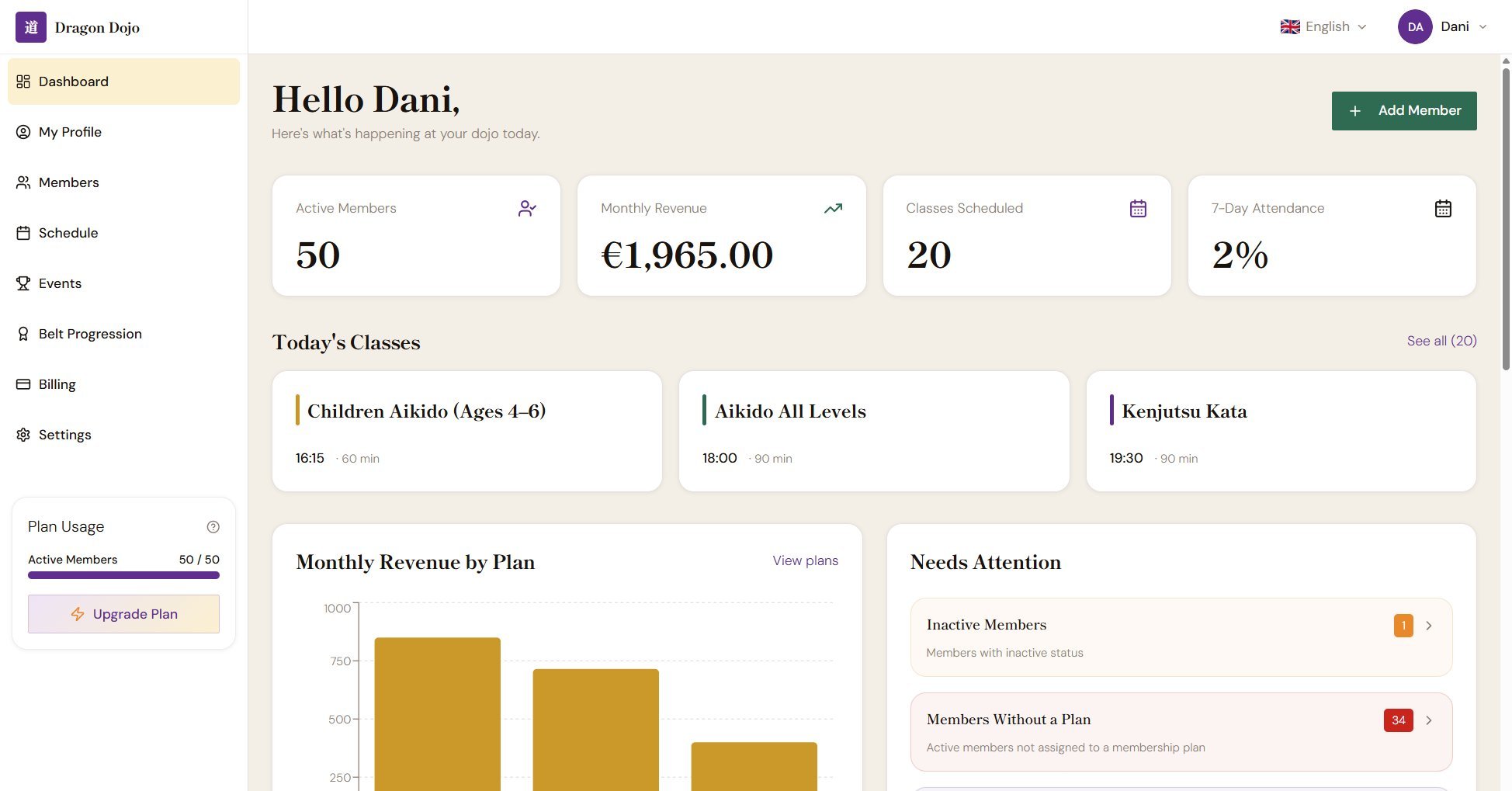
DojoMaster supports SEPA Direct Debit natively, generating mandates, sending pre-notifications, and collecting monthly dues automatically, with belt-testing fees and seminar tickets billed alongside it. Start free at dojomaster.app for up to 20 students, with paid plans from EUR 24/month.
Written by Daniil Pavliuchkov, 4th dan Aikido Aikikai and founder of DojoMaster. Sources: Stripe US pricing, Stripe Ireland pricing, Regulation (EU) 2015/751, Commission Delegated Regulation (EU) 2018/389, Federal Reserve Regulation II interchange data, Deutsche Bundesbank, European Payments Council, Nacha, ABC Fitness, GoCardless, Stripe, Intrum, Intuit QuickBooks, PCI Security Standards Council, Norton Rose Fulbright.