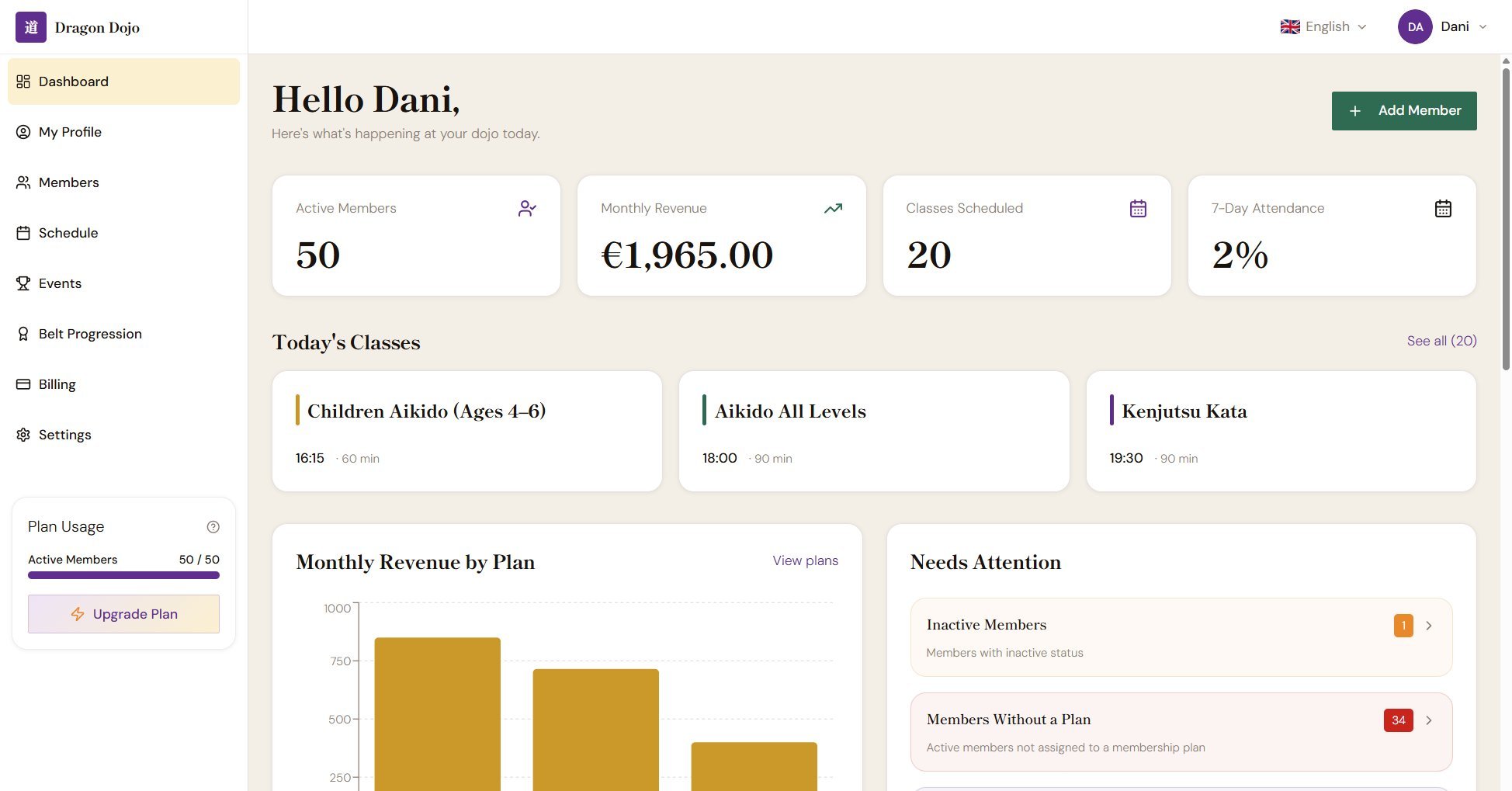

I should say plainly that I founded DojoMaster, so this is a comparison written by someone with an interest in the outcome. I have tried to write it the way I would want a competitor to write about us. Every DojoTrack figure below comes from its own public pages, checked on 14 November 2026. Where its site does not answer a question, the article says so and leaves the question open.
Key Takeaways
- DojoTrack costs $95 to $245 a month. That is the price once a school passes 50 students: $95 up to 100 students, $125 up to 200, $165 up to 300, $195 up to 500 and $245 above that (DojoTrack, November 2026).
- DojoTrack's free plan has many other limits. It holds 50 students, more than DojoMaster's 20, but allows only 10 class schedules, 25 enquiries, 3 staff, 90 days of attendance history and 1 waiver, with billing by hand or in cash.
- DojoMaster's free plan includes every feature. It covers up to 20 members with SEPA Direct Debit, belt grading and kiosk check-in all switched on. After that it costs EUR 24, EUR 59 or EUR 119 a month by size, and only the member limit changes.
- DojoMaster collects euros by SEPA Direct Debit. Direct debits are 14% of all payments in Europe that are not made in cash, and about 31% in Germany (European Central Bank, July 2026).
- DojoMaster records a grading from a photo. You photograph the examiner's list after the grading, DojoMaster reads the names and matches them to your students, and you check the matches before the new belts are saved.
If you want to compare the whole market, our breakdown of what dojo management software actually costs in 2026 covers the field, and our guide to free versus paid dojo management software looks at every free tier on offer.
What Is DojoTrack?
DojoTrack is software for running a martial arts school: students, enquiries, classes and billing in one place. It describes itself as a martial arts CRM, which is an abbreviation for customer relationship management, meaning a system that tracks people who have enquired about joining as well as people who have already joined.
The company is DojoTrack LLC, based in Utah. Its about page says the product launched in 2024 and was founded by Jared Reed, who spent more than two decades in martial arts as a competitor, instructor and manager before building it (DojoTrack, November 2026). That makes it roughly two years old. Its contact page describes its focus as martial arts software for studios in the USA, and names Taekwondo, Jiu-Jitsu, Karate and MMA schools as the customers it serves (DojoTrack, November 2026).
Two things stand out in the product itself. The first is how much it puts on the free plan: artificial-intelligence retention scores, which flag students whose attendance and payment patterns suggest they may stop training, and lead scoring, which ranks new enquiries by how likely they look to sign up, are both on the free plan. The second is how much of the day-to-day running of a school sits on the paid tier, including automatic payments, kiosk check-in, meaning a tablet by the door that students sign in on themselves, and automated belt promotions.
What Is DojoMaster?
DojoMaster is dojo management software built in Europe, first of all for collecting tuition there. It collects the monthly fees by SEPA Direct Debit and matches what arrives in the bank to the right students. Around that sit the things a school uses every week: belt grading with promotion readiness, meaning a view of who has trained enough for their next grading, kiosk and QR check-in on a tablet by the door, class scheduling, events with paid tickets, digital waivers, staff access levels with an audit log, and an interface in 16 languages. Three AI assistants take on admin work: setting up an event from a link to its web page, reading the examiner's list after a grading from a photo, and drafting a waiver.
The Free Plans Compared
DojoTrack's free plan holds more students and does less with them; DojoMaster's holds fewer and does everything.
DojoTrack's free plan holds up to 50 students against DojoMaster's 20, so on student count alone DojoTrack gives you more than twice the room. What the headline does not show is that DojoTrack's free plan also caps most of the rows below it, while DojoMaster's free plan caps only the member count.
| On the free plan | DojoMaster | DojoTrack |
|---|---|---|
| Students or members included | Up to 20 | Up to 50 |
| Class schedules | No limit | Up to 10 |
| Attendance history kept | Full history | 90 days |
| Automatic recurring payments | Included | Paid tier only, billing by hand or cash on free |
| SEPA Direct Debit | Included | Ask DojoTrack |
| Belt grading | Included, with promotion readiness | Ranks on student profiles; automated promotions on the paid tier |
| Kiosk check-in on a tablet | Included | Paid tier only |
| Digital waivers | No template limit | 1 template |
| Staff accounts | No limit, with access levels | Up to 3, with shift scheduling |
| Enquiries tracked | No enquiry tracking in the product | Up to 25, plus 1 website form |
| AI retention and lead scores | No | Included |
| Credit card needed to start | No | No |
Sources: the DojoTrack pricing page, free plan page and features page, checked 14 November 2026, and DojoMaster's own pricing.
Read down that table and the shape of each free plan becomes clear. DojoTrack's is a sample of a larger product: room for 50 students, with the things a school does every week kept back for paying customers. DojoMaster's is a small but complete school: fewer members, and everything the software does is switched on, SEPA collection and kiosk check-in included.
Which free plan suits you depends on what you want to test during the free period. If you want to see whether the software can hold your whole club, DojoTrack's 50 students will show you that and DojoMaster's 20 will not. If you want to see whether it can collect your tuition without you reminding anybody to pay, DojoMaster's free plan will show you that and DojoTrack's will not. On DojoTrack's free plan, payments are collected by hand or in cash until you move to a paid plan.
One more limit matters, because owners rarely think about it until it bites: DojoTrack's free plan keeps only 90 days of attendance history. Attendance over a longer span is what tells you that a student who trained three times a week in spring now comes once every two weeks. It also matters at a grading: in my own dojo the gap between gradings was longer than three months, so a 90-day window would not have covered a single grading cycle. With three months of records you can see that a student comes less often, but you cannot see how often they came before.

Pricing Compared
Above 50 students DojoMaster is cheaper at every size. Between 21 and 50 students DojoTrack is free and DojoMaster is not. Both products charge by how many students you have, and neither charges by feature.
DojoTrack publishes five paid tiers and states that they differ only in capacity: "the only difference is how many students you can enroll" (DojoTrack, November 2026). DojoMaster works the same way, with three paid tiers and every feature on all of them. That makes the two unusually easy to compare, because you only have to line up the price at each school size.
| School size | DojoMaster | DojoTrack |
|---|---|---|
| Up to 20 students | Free, permanently | Free, permanently |
| 21 to 50 students | EUR 24/mo (EUR 19 billed annually) | Free, permanently |
| 51 to 100 students | EUR 59/mo (EUR 49 billed annually) | $95/mo (Launch) |
| 101 to 200 students | EUR 119/mo (EUR 99 billed annually) | $125/mo (Scale) |
| 201 to 300 students | EUR 119/mo, no higher tier | $165/mo (Expand) |
| 301 to 500 students | EUR 119/mo, no higher tier | $195/mo (Grow) |
| 501 students and up | EUR 119/mo, no higher tier | $245/mo (Master) |
| Currency you are billed in | EUR | USD |
| Annual discount | Published on every tier | Not published |
| Setup or onboarding fee | None | None published |
| Every feature on every plan | Yes | Yes on the paid tiers |
| Cancelling | Any time, no minimum term | Any time, account runs to the end of the paid period |
Sources: the DojoTrack pricing page and terms of service, checked 14 November 2026, and DojoMaster's own pricing. DojoMaster is our own product. Prices are list rates in each vendor's own currency and are not converted here. DojoMaster's bands are 20, 50 and 100 members, with EUR 119 covering everything above 100, so the rows follow DojoTrack's bands and give DojoMaster's price within each one.
Three things in that table matter more than the rest.
Between 21 and 50 students, DojoTrack is free and DojoMaster is not. That is a real gap and the clearest case for choosing DojoTrack on price. A school of 40 pays EUR 24 a month for DojoMaster and nothing at all for DojoTrack, as long as 10 class schedules, 3 staff, 90 days of attendance and collecting money by hand are enough for it.
Above 50 students DojoMaster is cheaper, and the difference grows with the school. At 80 students the comparison is EUR 59 against $95. At 400 it is EUR 119 against $195, because DojoMaster's prices stop rising at 100 members and DojoTrack's keep rising up to 500 and beyond.
DojoTrack bills in US dollars. For a school outside the United States, a dollar price on a euro card usually brings a conversion charge from your own bank every month, and the amount in euros changes with the exchange rate.
Features Compared
Both products cover the basics of running a school. DojoTrack does more for finding and signing up new students. DojoMaster does more for collecting money in Europe, for belt gradings, and for running a dojo in more than one language. DojoMaster has no shop for selling gear, no enquiry tracking and no automatic text messages, and students get an installable web app, with no branded app in the app stores. DojoTrack has all of those, most of them on its paid tier.
| Feature | DojoMaster | DojoTrack |
|---|---|---|
| Belt and rank tracking | Yes, with promotion readiness | Yes, automated promotions on the paid tier |
| Attendance tracking | Yes, full history | Yes, 90 days on free, full history paid |
| Kiosk check-in on a tablet | Yes, on every plan | Yes, on the paid tier |
| Class scheduling | Yes | Yes |
| Automatic recurring payments | Yes | Yes, on the paid tier, through Stripe |
| Card payments | Yes | Yes, saved cards through Stripe |
| Cash and manual payments | Yes | Yes, on every plan |
| SEPA Direct Debit (euro bank accounts) | Yes, native, payments matched to students automatically | Ask DojoTrack |
| Interface languages | 16 | Ask DojoTrack |
| Digital waivers | Yes | Yes, with e-signatures |
| Staff access levels and audit log | Yes, with an audit log | Staff roles, clock-in and pay on the paid tier |
| Events and ticketing | Yes, with paid tickets | Free event registration; paid event fees on the paid tier |
| Family billing and sibling discounts | No, each member is billed separately | Yes, siblings on one household bill, on the paid tier |
| Enquiry tracking and follow-up | No | Yes, with AI lead scoring on every plan |
| Text messaging to students | No | Yes, on the paid tier |
| Selling gear in the dojo | No | Yes, on the paid tier |
| App for students | Installable web app (PWA), not a branded native app | Branded app, on the paid tier |
| AI help with admin | Yes, events from a web link, exam lists from a photo, waiver drafts | Yes, retention and lead scores free, help chat paid |
| Permanent free tier | Yes, up to 20 members | Yes, up to 50 students |
Sources: the DojoTrack features page, paid plans page and pricing page, checked 14 November 2026. Where a row says "Ask DojoTrack", its site does not discuss that capability either way, so we have not assumed an answer.
Two rows in that table matter more than the others, so they get a sentence each.
Family billing is a gap in DojoMaster. A dojo with many children on the mat usually has several families paying for two or three siblings. DojoTrack's features page describes linking "siblings under one household" on a single membership, with sibling pricing applied automatically (DojoTrack, November 2026). DojoMaster bills each member separately today, so an owner works out family discounts themselves.
Enquiry tracking is the other. If what keeps you awake is that people call, ask about classes and are never heard from again, DojoTrack has tools for following them up. DojoMaster has none.
Where DojoMaster Goes Further: Gradings Without the Paperwork
Belt gradings are where DojoMaster saves an owner the most admin. Before a grading, the Belts & Grading page shows, next to each student's belt, whether they can grade now, in a few days, or not yet. It works this out from the requirements you set for each belt and the attendance already in the system, so nobody counts classes by hand.

After the grading, the examiner's list is usually a sheet of paper. You take a photo of it and drop it onto the Record Exam Results page. An AI assistant reads the names, and DojoMaster matches each one to a student. Names it is sure about go onto the list at once, a name it is less sure about waits for your approval, and a name it cannot find, such as a student visiting from another dojo, you link to the right person or remove. On the next step you set each student's new belt, mark who passed, and save. Belt history and promotion readiness update by themselves, and nobody types names from the paper into the system.


How the Money Actually Reaches You
If your students pay in euros, this is the section that decides the comparison. It needs a short explanation first, because the mechanism is unfamiliar to anyone who has not used it.
SEPA stands for the Single Euro Payments Area, the set of rules that lets euro payments move between banks in 36 European countries on the same terms (European Payments Council, 2025). A SEPA Direct Debit mandate is a standing permission a student signs once. It lets your school take the monthly fee from their bank account on a fixed day, so the student does not have to send a transfer each month or keep a card on file. Our guide to what a SEPA Direct Debit mandate is walks through the wording and the notice periods in full.
It matters because in Europe this is how recurring bills are normally paid. Direct debits were 14% of all payments in Europe that were not made in cash in the second half of 2025, and in Germany the share was about 31% (European Central Bank, published July 2026). That share covers all kinds of bills, dojo fees among them, and it tells you what a German or Dutch parent expects to be offered when they sign their child up. In the United States the same job is usually done by a card on file, which is why American products usually start with card payments.
DojoMaster handles this monthly cycle on its Accounting page. It keeps the mandates and prepares the collection file you upload to your bank. When the bank statement comes back, you drop it onto the same page, and DojoMaster matches each payment to the right student and marks the ones that failed, with the bank's reason code next to them, so you only deal with those few yourself. Cards and cash work too, for the students who prefer them.

DojoTrack names Stripe as its payment processor and describes automatic subscriptions with saved cards. Each region has its own direct debit system with its own rules: ACH in the United States, Bacs in the United Kingdom and SEPA in Europe. Ask any vendor which of them it would actually use to collect your fees, and in which currency it would bill you, before you sign up.
The practical difference for a European dojo is in what happens every month without you. A card on file expires, gets replaced after a fraud alert, or is declined because the student's salary has not landed yet, and each of those turns into a message you have to send. A mandate keeps working month after month and only lapses if you go 36 months without collecting on it (European Payments Council, 2025), which on an ordinary monthly membership never happens. For a small club this is the difference between spending an evening a month on money and spending none.
What the Review Sites Say
Neither product has user reviews yet, so reviews cannot help you choose between them.
DojoTrack has a listing on the software directory Capterra carrying no user reviews, last updated in March 2026 (Capterra). DojoMaster's Capterra listing has none either. Neither product has a page on G2 or Trustpilot. That is normal for products this young and says nothing bad about either of them. It does mean you cannot read a few hundred reviews before you decide.
One more point affects the price you will see. Capterra's regional listings for DojoTrack disagree with each other and with DojoTrack's own site: its United States listing gives $95, which matches DojoTrack's own page, while its Irish listing gives US$125. Both mention a free trial, which DojoTrack's own pages do not advertise: they describe a free plan that simply does not expire. Directory listings go stale. Take the price from the vendor's own page on the day you buy.
If you want comparisons with a larger review record behind them, we have the same head-to-head against Zen Planner, Gymdesk and Kicksite.
When DojoTrack Is the Better Choice
- Your school has between 21 and 50 students and you want to pay nothing. DojoTrack's free plan covers that range and DojoMaster's stops at 20.
- You bill in dollars. DojoTrack is built for schools in the United States and its prices are in dollars.
- Getting new students through the door is your main problem. Enquiry tracking, lead scoring and automated follow-up by text are in the product, and the scoring is on the free plan.
- You have a lot of families with several children training. One household bill applies sibling discounts automatically.
- You sell gear in the dojo. DojoTrack can take payment for gear on the spot and keep track of stock, on its paid tier.
- You want your school's own app on students' phones, with class schedules and push notifications.
- You want staff clock-in and pay tracking alongside shift scheduling.
When DojoMaster Is the Better Choice
- Your students pay in euros. SEPA collection is on the free plan, where DojoTrack's free plan bills by hand or in cash, so a euro-collecting school gets the thing it most needs without paying first.
- You want the free plan to be the real product. Up to 20 members with SEPA collection, belt grading and kiosk check-in all switched on, so what you try is what you would buy.
- You want to be billed in euros, with no conversion charge on the invoice each month.
- Your students or their parents do not all read English. Sixteen languages matters in a European club where some families are new to the country.
- You keep attendance over years, not months. Full history, which is also what tracking belt promotions digitally depends on when you work out who is ready to grade.
- You want gradings with less paperwork. Promotion readiness shows who can grade, and a photo of the examiner's list records the results.
- You do not want instructors seeing payment data. Staff access levels and an audit log are standard, not a paid tier.
- You are moving records from another system. The import reads an ordinary spreadsheet export and recognises the columns by itself, and a spreadsheet is the form your members, contact details and belt grades will arrive in from DojoTrack or from a dojo that has outgrown its spreadsheet.

What Switching Actually Involves
Moving between these two products has three specific problems. The student list is the easy part: names, contact details and belt grades can be exported as a spreadsheet from any system, and both products import one.
The first problem is attendance history. DojoTrack's free plan keeps 90 days of it, so ask DojoTrack whether anything older than that still exists and can be exported before you plan a move. If attendance history matters to your gradings, start recording attendance in the new system now, alongside the old one, before you decide to move.
The second is the payment arrangement, which is the part that takes real time in either direction. The payment processor holds the card details, and the school never sees them, so students generally have to enter them again. Existing SEPA mandates may or may not be transferable depending on who holds them, so put that question to your current provider before you plan a date.
The third is refunds. DojoTrack's terms state that it "does not offer refunds for any reason whatsoever", including unused time on a period you have paid for (DojoTrack, November 2026), though you can cancel whenever you like and the account runs to the end of that period. DojoMaster does not publish a refund policy either, so put the same question to us. With both of them, finish testing on the free plan before you pay for a long period.
Whichever way you go, run both systems side by side for one billing month and move everyone at the end of it. Pick a quiet month. September, when many new students join, is the worst time.

The Verdict
Two questions decide this comparison: how many students you have, and which currency they pay in.
The first is how many students you have right now. Between 21 and 50, DojoTrack is free and DojoMaster is EUR 24 a month, and if collecting money by hand is acceptable to you then that is a straightforward saving. Above 50 students DojoMaster is cheaper, and the difference grows with the school, because DojoMaster's price stops at EUR 119 and DojoTrack's rises to $245.
The second is which currency your students' money sits in. If it is dollars, DojoTrack is built for your school, priced in your currency and aimed at your market. If it is euros, DojoMaster was built for exactly that, and you will notice the difference every month when the tuition comes in.
One piece of advice applies whatever you choose. Sign ten real students up on each free plan and run a month of fees through both. That is the only test that shows how each product works for your own school. Both products are free to start, so the test costs you an evening and no money.
If you want to look wider before deciding, our guide to dojo management software covers what the whole category does, and our roundup of attendance tracking apps goes deeper on the one feature most owners use every single day.
Frequently Asked Questions
Is DojoTrack free?
DojoTrack has a permanent free plan for up to 50 students, with no credit card needed and no expiry date. The free plan limits several other things: 10 class schedules, 25 enquiries, 3 staff members, 90 days of attendance history, 1 waiver template and 1 website form, and billing is by hand or in cash, because automatic payments are on the paid tiers. Paid plans start at $95 a month for up to 100 students.
Is DojoMaster cheaper than DojoTrack?
It depends on the size of your school. Between 21 and 50 students DojoTrack is free and DojoMaster costs EUR 24 a month, so DojoTrack is cheaper. Above 50 students DojoMaster is cheaper at every size: EUR 59 against $95 at 80 students, EUR 119 against $125 at 150, and EUR 119 against $195 at 400, because DojoMaster's price stops at EUR 119 above 100 members while DojoTrack's ladder continues to $245. Both are free up to 20 students.
Is DojoMaster a good DojoTrack alternative?
It is the closer alternative for a school in Europe and the weaker one for a school in the United States. DojoMaster bills in euros, collects by SEPA Direct Debit and runs in 16 languages, and it is cheaper at every size above 50 students. It does not have DojoTrack's enquiry tracking, text messaging, gear sales or family billing, so a school whose main problem is finding new students will miss them.
How does DojoMaster collect fees from a euro bank account?
Through a SEPA Direct Debit mandate, which is a standing permission the student signs once that lets the school take the monthly fee from their bank account. DojoMaster keeps the mandates, prepares the collection file you upload to your bank, reads the bank statement back, matches each payment to the right student automatically and marks the ones that failed. The mandate keeps working until the student cancels it or 36 months pass with no collection.
What is the difference between the two free plans?
DojoTrack's free plan holds more students, 50 against DojoMaster's 20, and limits what you can do with them: 10 class schedules, 3 staff, 90 days of attendance history and no automatic payments. DojoMaster's free plan holds fewer members and limits nothing else, so SEPA Direct Debit, belt grading with promotion readiness and kiosk check-in are all included. DojoTrack's free plan is a larger sample of a bigger product; DojoMaster's is a smaller but complete school.
Which is better for a European dojo, DojoMaster or DojoTrack?
For a school collecting fees in euros, DojoMaster fits better. It collects by SEPA Direct Debit, bills you in euros and runs in 16 languages, where DojoTrack bills in US dollars and describes its focus as studios in the USA. DojoTrack may suit a European school whose main problem is recruiting new students, since its enquiry tracking and lead scoring have no equivalent in DojoMaster.
Written by Daniil Pavliuchkov, 4th dan Aikido Aikikai and founder of DojoMaster. DojoTrack pricing, plan caps, free-plan limits, features, payment processor, company history and refund terms verified 14 November 2026 from its pricing page, free plan page, paid plans page, features page, about page, contact page and terms of service; directory listings and review counts from Capterra and its Irish listing; SEPA mandate rules from the EPC SDD Core Rulebook, 2025; euro area payment figures from the European Central Bank's payments statistics for the second half of 2025, published July 2026.